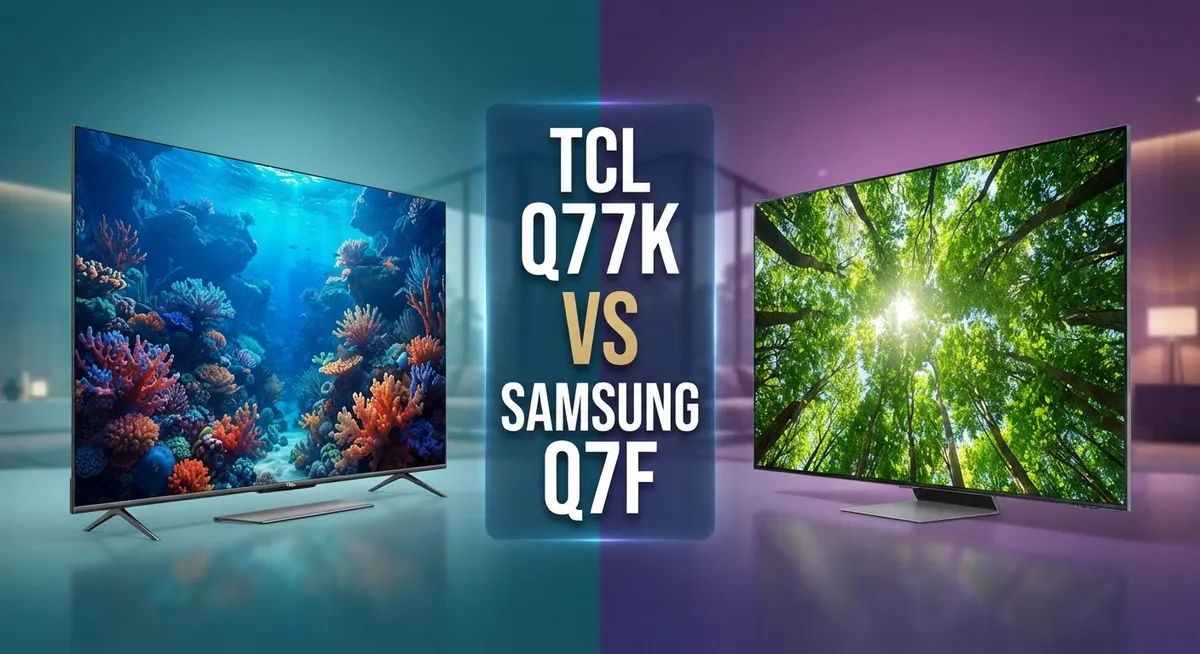
TCL Q77K vs Samsung Q7F: Features, Specs & Performance
Picking a new 4K TV can feel like a big decision. Two models often come up in the same conversation: the TCL Q77K and the Samsung Q7F.
Both promise sharp visuals and modern style. But they serve very different types of viewers.
The TCL Q77K packs in gaming-friendly features like HDMI 2.1 and VRR. It also offers smooth motion and strong local dimming for deeper contrast.
The Samsung Q7F takes a simpler approach. It focuses on solid color accuracy and black levels, but skips advanced gaming tech and local dimming entirely.
So which one fits your living room best? That depends on how you watch, play, and light your space.
This guide breaks down every key spec, strength, and weakness side by side. We will help you decide which TV truly earns a spot in your home.
Quick Comparison: TCL Q77K vs Samsung Q7F
| Feature | TCL Q77K | Samsung Q7F |
|---|---|---|
| Refresh Rate | 144Hz @ 4K / 288Hz @ 1080p | 60Hz |
| HDMI Version | HDMI 2.1 | No HDMI 2.1 |
| VRR Support | Yes | No |
| Local Dimming | Full-array, 242 zones (65″) | None, 96 zones (65″) |
| Input Lag | 10-13ms | Higher (not gaming-focused) |
| HDR Formats | HDR10, Dolby Vision | No Dolby Vision |
| Processor | Standard 4K processor | Q4 AI Processor |
| Best Use Case | Gaming, budget premium features | Basic viewing, controlled lighting |
TCL Q77K Review

- 4K UltraHD Resolution: Experience incredible detail with 4X the resolution of 1080p Full HDTVs
- QLED (Quantum Dot Technology): Rich, vibrant colors covering nearly the entire DCI-P3 color space to bring images to...
- 144Hz Panel Refresh Rate: Watch action-packed movies, fast-paced video games, and live sports with an ultra-smooth...

Last update on 2026-09-13 / Affiliate links / Images from Amazon Product Advertising API
The TCL Q77K is a 4K gaming TV that brings high-end features to a practical package. It’s built for gamers and anyone who wants smooth, responsive performance without unnecessary extras.
This model shines with HDMI 2.1 support and variable refresh rate (VRR) technology. You get 288Hz refresh at 1080p and 144Hz at 4K, plus an input lag of just 10–13ms for snappy gameplay.
The full-array local dimming system delivers strong contrast control with excellent black levels. Viewing angles stay decent across the room, and motion performance feels fluid during fast scenes.
Real-world use shows crisp HDR10 and Dolby Vision content, solid color accuracy, and smooth frame rates. The TV handles everything from console gaming to streaming without breaking a sweat.
Pros
- HDMI 2.1 and VRR unlock next-gen console gaming at high refresh rates
- Full-array local dimming creates deep blacks and punchy contrast
- Low input lag keeps gameplay responsive and competitive-ready
- Excellent motion handling and smooth scrolling across all refresh rates
Cons
- Motion blur can appear at 60Hz in some scenes (user reports vary)
- Mirror-like reflections make it difficult to reduce glare in bright rooms
Samsung Q7F Review

- POWERS DRAMATICALLY CLEAR COLOR AND SOUND: Enjoy your movies and shows in stunning 4K, regardless of the source...
- OVER A BILLION COLORS THAT STAY TRUE EVEN IN THE BRIGHTEST SCENES**: Appreciate every beautiful shade of color with...
- SECURES PERSONAL DATA*** WITH TRIPLE-LAYER PROTECTION: Your TV experiences are secured. Samsung Knox Security defends...
Last update on 2026-09-13 / Affiliate links / Images from Amazon Product Advertising API
The Samsung Q7F is a straightforward 4K TV built for viewers who want clean image quality without gaming bells and whistles. This model suits anyone watching movies, streaming shows, or browsing content in rooms with controlled lighting.
The Q7F runs on Samsung’s Q4 AI Processor, which upscales lower-resolution content and fine-tunes colors automatically. You get solid black levels and decent color accuracy when ambient light stays moderate.
The panel delivers a basic but reliable viewing experience with standard 60Hz refresh rates and no local dimming system. Build quality feels solid, though the feature set remains intentionally minimal compared to gaming-focused competitors.
Real-world performance shows this TV handles SDR and standard HDR content well in darker spaces, but brightness drops noticeably under bright sunlight or strong room lighting.
Pros
- Good black levels and color accuracy in controlled lighting environments
- Clean, user-friendly interface with Samsung’s smart TV ecosystem
- Reliable everyday performance for streaming and movies
- Solid build quality at its price segment
Cons
- Insufficient brightness for bright rooms or daytime viewing
- No local dimming, VRR, HDMI 2.1, or gaming features
- Limited to 60Hz refresh rate with no motion smoothing tech
- No Dolby Vision or DTS audio support
Head to Head: Key Differences
The TCL Q77K and Samsung Q7F represent two very different approaches to 4K television. The TCL brings gaming-first engineering, while the Samsung focuses on basic, everyday viewing.
Dimming and contrast control separate these models most clearly. The TCL Q77K uses full-array local dimming with 242 zones (on 65″), which means the TV can darken specific screen areas independently.
The Samsung Q7F has no local dimming at all, relying only on standard panel backlighting.
Gaming features heavily favor the TCL. The Q77K includes HDMI 2.1, variable refresh rate (VRR), and 144Hz support at 4K, making it ready for next-gen consoles and high-end PC gaming.
The Samsung Q7F maxes out at 60Hz with no VRR or HDMI 2.1, so fast-action games feel less smooth.
Input lag and responsiveness matter for interactive content. The TCL Q77K delivers 10 to 13ms input lag, keeping gameplay sharp and competitive.
The Samsung Q7F doesn’t prioritize this metric, making it less ideal for real-time gaming.
Brightness in bright rooms shows a real weakness for the Samsung. The Q7F struggles with SDR brightness when sunlight fills your space.
The TCL handles bright environments better thanks to its dimming zones and stronger panel output.
Smart TV experience runs differently on each. Samsung’s Q4 AI Processor upscales lower-resolution content automatically.
The TCL offers solid format support and smooth motion across all refresh rates.
Best use case depends on your habits. Choose the TCL if you game, watch fast-action sports, or sit in bright rooms.
Pick the Samsung if you watch standard content in controlled lighting and skip gaming entirely.
Which One Should You Buy
The TCL Q77K stands out as the clear winner in this matchup. It packs full-array local dimming, HDMI 2.1, VRR, and Dolby Vision into one package.
These features give it a real edge in picture quality and gaming performance. The Samsung Q7F simply cannot match this level of technology.
If you want a TV that grows with your needs, the TCL Q77K is the smarter pick. It delivers a well-rounded experience that feels future-proof.
Best for each buyer – TCL Q77K: Perfect for gamers and enthusiasts who want smooth motion, sharp contrast, and a premium home theater setup. – Samsung Q7F: Great for casual viewers in controlled lighting who just want solid 4K picture without extra gaming or HDR frills.
Frequently Asked Questions
Which TV handles fast-paced gaming better?
The TCL Q77K dominates gaming performance. It supports HDMI 2.1, which unlocks 144Hz at 4K and 288Hz at 1080p.
VRR (variable refresh rate) keeps frame rates smooth during action scenes. Input lag sits around 10-13ms, so your button presses register instantly.
The Samsung Q7F maxes out at 60Hz with no VRR support. Fast games feel choppy.
There’s no HDMI 2.1, so you can’t access modern gaming features at all.
Does the Samsung Q7F work in bright rooms?
Not really. The Q7F struggles with brightness in sunny spaces.
SDR content becomes washed out when ambient light is high. You’ll need controlled lighting to enjoy its full potential.
The TCL Q77K handles bright rooms much better. Its full-array local dimming system creates deeper blacks even with lights on, making contrast pop.
What’s the main picture quality difference?
Local dimming is the game-changer. The TCL has 242 dimming zones (on 65″), giving it precise control over brightness in different screen areas.
This creates punchy contrast and rich blacks.
The Samsung Q7F has no local dimming at all. It relies on basic backlighting, so blacks look grayer and contrast feels flat.
Is the Samsung Q7F good for non-gamers?
Yes, if you watch in darker rooms. The Q7F delivers solid color accuracy and decent black levels in controlled lighting.
The Q4 AI Processor upscales lower-resolution content smoothly. It’s straightforward and reliable for standard 4K movies and shows.
The TCL works for non-gamers too, but you’re paying for gaming features you won’t use.
Which TV has better motion handling?
The TCL Q77K excels here. High refresh rates and smooth motion processing make scrolling and panning look buttery.
Motion blur is minimal across all refresh rates.
The Samsung Q7F is locked at 60Hz, so motion feels standard and less fluid.

Tian is a passionate technology enthusiast and reviewer who explores the latest in AI tools, gadgets, and digital innovations to help readers make informed tech decisions.