TCL Q77K vs Samsung Q6F: Mini-LED vs QLED Comparison for HDR Performance
Picking a new TV can feel confusing. There are so many models to choose from.
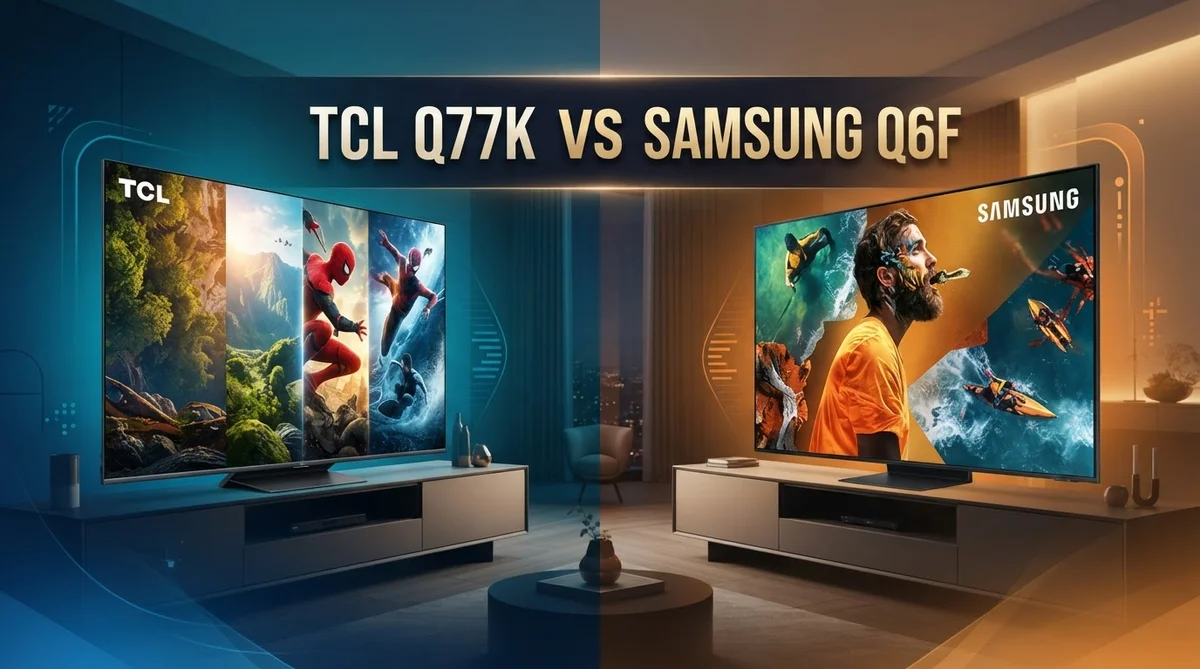
Today we compare two popular options: the TCL Q77K and the Samsung Q6F. Both promise great picture quality, but they come from different eras of TV technology.
The TCL Q77K brings modern features like Mini-LED backlighting and HDMI 2.1 support. It targets gamers and anyone who wants smooth, sharp visuals.
The Samsung Q6F is an older QLED model. It still holds up for casual viewing, but its technology shows its age.
This guide breaks down specs, strengths, and weaknesses for each TV. We look at picture quality, gaming performance, and overall value.
By the end, you will know exactly which TV fits your needs. Whether you want a serious gaming upgrade or a simple everyday screen, we help you decide.
Let’s dive into the details and find your perfect match.
Quick Comparison: TCL Q77K vs Samsung Q6F
| Feature | TCL Q77K | Samsung Q6F |
|---|---|---|
| Display Type | Mini-LED | QLED (edge-lit) |
| Backlighting | Full array local dimming | Edge-lit |
| HDMI Version | HDMI 2.1 | Not specified (older HDMI) |
| Refresh Rate | 144Hz @4K / 288Hz @1080p | Standard refresh rate |
| Input Lag | 10-13ms | Higher (not gaming-focused) |
| HDR Support | HDR10/Dolby Vision | Basic HDR, low brightness |
| Brightness | High (Mini-LED) | 250 nits |
| Release Year | Recent model | 2018 model |
TCL Q77K Review

- 4K UltraHD Resolution: Experience incredible detail with 4X the resolution of 1080p Full HDTVs
- QLED (Quantum Dot Technology): Rich, vibrant colors covering nearly the entire DCI-P3 color space to bring images to...
- 120Hz Panel Refresh Rate: Watch action-packed movies, fast-paced video games, and live sports with an ultra-smooth...

Last update on 2026-09-13 / Affiliate links / Images from Amazon Product Advertising API
The TCL Q77K is a modern 4K Mini-LED TV that brings gaming-focused features to a wide range of room sizes, from 55 inches up to 98 inches. It suits gamers, PC monitor users, and anyone seeking sharp contrast without breaking the bank on premium brands.
This TV packs HDMI 2.1 support and 144Hz refresh rates at 4K, making it a serious contender for next-gen console and PC gaming. The Mini-LED backlighting system delivers full array local dimming, which means precise brightness control across the screen for deep blacks and bright highlights.
Real-world performance shines with 10-13ms input lag and smooth motion handling. HDR10 and Dolby Vision support round out the picture, giving you rich colors and detail in supported content.
Build quality feels solid across all screen sizes.
One area to watch: some users report motion blur at standard 60Hz refresh rates, though reviews conflict on this issue. Reflections can also be tricky in bright rooms, so placement matters.
Pros
- HDMI 2.1 and 144Hz @ 4K enable next-gen gaming without compromise
- Full array local dimming creates superior contrast compared to edge-lit rivals
- Input lag under 15ms keeps competitive gaming responsive
- Available in multiple sizes to fit any living space
Cons
- Motion blur reports at 60Hz create some confusion about real-world smoothness
- Direct reflections require careful TV placement away from bright light sources
Samsung Q6F Review

- POWERS DRAMATICALLY CLEAR COLOR AND SOUND: Enjoy your movies and shows in stunning 4K, regardless of the source...
- OVER A BILLION COLORS THAT STAY TRUE EVEN IN THE BRIGHTEST SCENES**: Appreciate every beautiful shade of color with...
- SECURES PERSONAL DATA*** WITH TRIPLE-LAYER PROTECTION: Your TV experiences are secured. Samsung Knox Security defends...
Last update on 2026-09-18 / Affiliate links / Images from Amazon Product Advertising API
The Samsung Q6F is a QLED TV from 2018 that focuses on color accuracy and brightness for everyday viewing. This model works best in well-lit rooms and for light gaming sessions where you don’t need cutting-edge specs.
Its edge-lit backlighting delivers decent brightness at 250 nits, paired with strong audio output. The QLED panel handles colors well and supports HDR formats, though the implementation feels dated compared to modern alternatives.
Real-world performance shows good color reproduction and solid audio quality for a TV in this category. Build quality is respectable, though the older panel technology limits contrast performance in darker scenes.
Gamers should note the panel’s limitations: IPS technology means wider viewing angles but lower contrast, and the older refresh rate support won’t satisfy competitive players. General viewers in bright spaces will find the Samsung Q6F adequate for casual use.
Pros
- Good color accuracy and brightness for daytime viewing
- Strong audio performance built-in
- Solid HDR support with decent format compatibility
- Reasonable build quality across the frame
Cons
- Edge-lit backlighting creates poor contrast compared to full array designs
- 250 nits insufficient for true HDR impact in darker rooms
- Older 2018 technology with limited gaming features
- IPS panel trades contrast for viewing angles
Head to Head: Key Differences
The TCL Q77K and Samsung Q6F represent two different generations of TV technology. The TCL is a current-generation Mini-LED set, while the Samsung is a 2018 QLED model with fundamental design differences.
Backlighting technology separates these TVs most dramatically. The TCL Q77K uses full array local dimming with Mini-LED zones, delivering superior contrast and brightness control compared to the Samsung Q6F’s edge-lit design.
Edge-lit backlighting cannot match the precision that full array systems provide.
For gaming, the TCL Q77K pulls ahead significantly. It offers HDMI 2.1 support, 144Hz refresh rates at 4K, and input lag between 10 to 13 milliseconds.
The Samsung Q6F lacks these gaming specifications and relies on older connection standards.
Brightness levels differ noticeably in practice. The TCL Q77K achieves much higher peak brightness, which matters for HDR content impact.
The Samsung Q6F maxes out around 250 nits, making HDR less dramatic on screen.
Panel technology creates viewing angle tradeoffs. The Samsung Q6F uses an IPS panel that offers wider viewing angles but suffers from lower contrast.
The TCL Q77K prioritizes contrast and direct viewing performance over extreme side angles.
Motion handling shows mixed results on the TCL. Most users report smooth performance at 120Hz and above, though some mention motion blur at standard 60Hz refresh rates.
The Samsung handles standard motion adequately for everyday content.
Both TVs support HDR formats and deliver solid audio. However, the TCL Q77K’s modern architecture, superior brightness, and gaming features make it the stronger performer for most viewing scenarios.
The Samsung Q6F works best for general daytime viewing in bright rooms where its brightness and color accuracy shine.
Which One Should You Buy
The TCL Q77K takes the win in this matchup. It brings Mini-LED technology with full array local dimming to the table.
Gamers get an extra edge too. HDMI 2.1, higher refresh rates, and lower input lag make it a strong pick for fast-paced action.
The Samsung Q6F still holds value for simpler needs. Its edge-lit design works fine for casual viewing, but it falls behind in performance and features.
Best for each buyer – TCL Q77K: Perfect for gamers and PC monitor users who want high performance and modern features. – Samsung Q6F: Suited for general viewing in well-lit rooms and light gaming sessions.
Frequently Asked Questions
Which TV has better gaming performance?
The TCL Q77K wins for gaming. It supports HDMI 2.1, which unlocks 144Hz at 4K resolution.
Input lag sits between 10-13ms, perfect for competitive play. The Samsung Q6F uses older connection standards and lacks these gaming specs.
If you play fast-paced games, the Q77K delivers a noticeably smoother experience.
What’s the main difference in picture quality?
Full array local dimming makes the biggest difference. The TCL Q77K uses mini-LED technology with thousands of dimming zones.
This creates deep blacks and bright highlights at the same time. The Samsung Q6F uses edge-lit backlighting, which cannot match this precision.
You’ll see better contrast and more dramatic HDR on the Q77K.
Can I use these TVs as PC monitors?
Yes, both work as monitors, but the Q77K performs better. The 288Hz refresh rate at 1080p and 144Hz at 4K give you smooth motion for work and gaming.
Lower input lag also helps responsiveness. The Q6F handles basic PC use fine, but it lacks the high-refresh capabilities modern systems offer.
Which TV is better for everyday watching?
The Samsung Q6F suits casual viewing in bright rooms. It delivers solid color accuracy and strong audio.
The TCL Q77K also works well for movies and shows, with superior brightness and contrast. Both handle standard content well.
Choose the Q77K if you want more visual impact from HDR content.
Does the TCL Q77K have any drawbacks?
Some users report motion blur at 60Hz, though reviews conflict on this. Direct reflections can be difficult to manage on the screen.
The Samsung Q6F has more significant issues: it’s older technology with limited brightness for HDR, and edge-lit backlighting cannot compete with modern designs.

Tian is a passionate technology enthusiast and reviewer who explores the latest in AI tools, gadgets, and digital innovations to help readers make informed tech decisions.