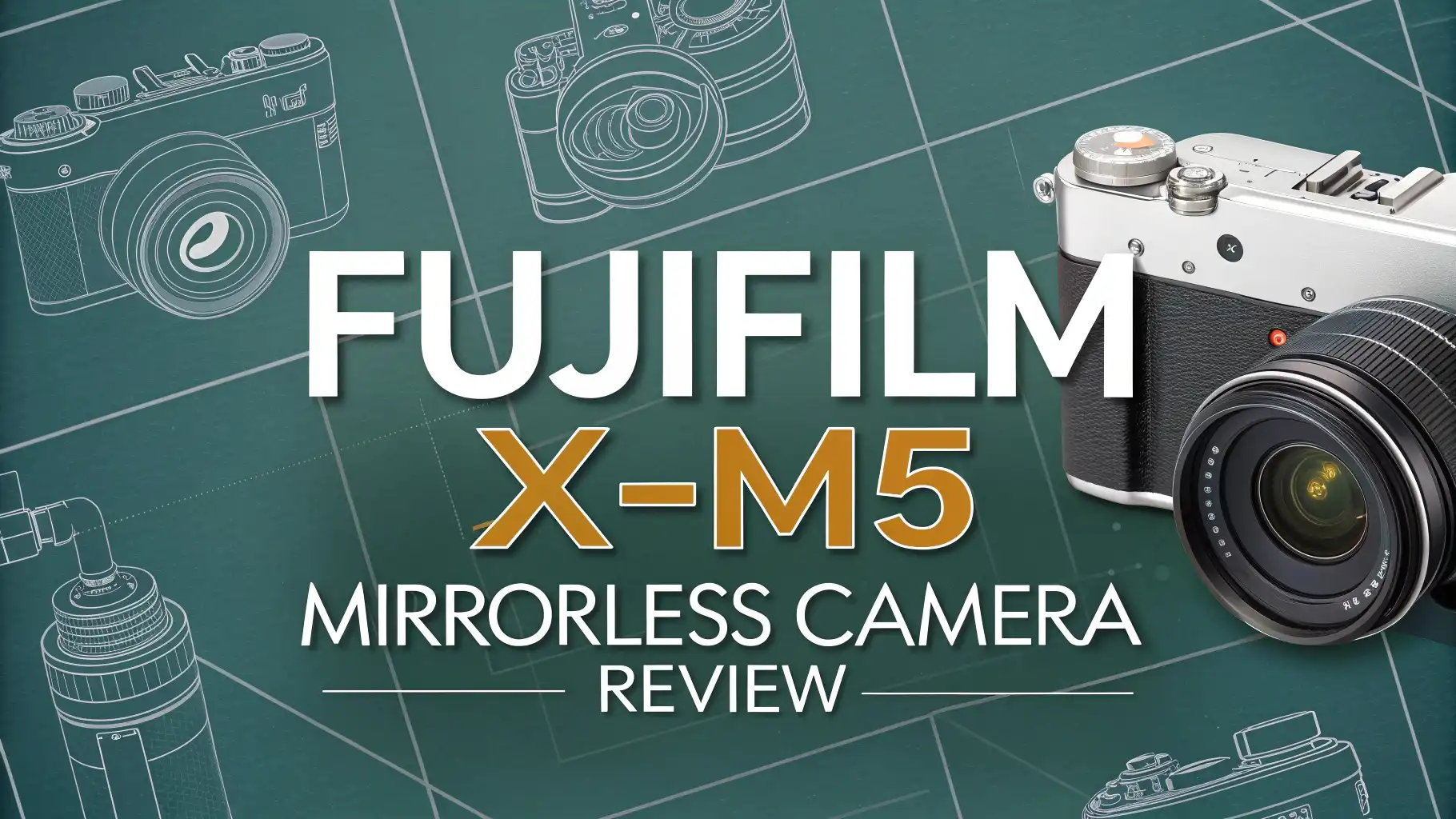
FUJIFILM X-M5 Mirrorless Camera Review: Compact Powerhouse
Are you searching for a mirrorless camera that combines professional image quality with ultra-compact design? The FUJIFILM X-M5 has arrived as a game changer in the entry-level camera market. This camera packs a 26.1MP sensor, AI-powered autofocus, and stunning video capabilities into the smallest X Series body ever created.
Whether you create content for social media, capture stunning photos, or shoot professional videos, this camera deserves your attention. Let me take you through everything you need to know about the X-M5 before you make your purchase decision.

Key Takeaways
Here’s what makes the FUJIFILM X-M5 stand out from the crowd:
- Ultra-Compact Design: The X-M5 is the smallest and lightest camera in the X Series lineup, making it perfect for travel and everyday carry without sacrificing image quality
- 26.1MP X-Trans CMOS 4 Sensor: This back-illuminated sensor delivers exceptional detail, rich colors, and impressive low-light performance that rivals much larger cameras
- AI-Powered Autofocus: Features the same intelligent subject detection technology found in premium models like the X100VI, ensuring sharp focus even with fast-moving subjects
- Content Creator Features: Three built-in microphones, 9:16 vertical video mode, Frame.io integration, and dedicated Film Simulation dial make this camera ideal for modern content creation
- Budget-Friendly Price: At $799 for the body only, the X-M5 offers flagship features at an entry-level price point, delivering incredible value for both beginners and experienced photographers
- No Electronic Viewfinder: This is the main compromise for the compact size, as the camera relies solely on the LCD screen for composition
What Makes the FUJIFILM X-M5 Special

- 26.1 Megapixel APS-C X-Trans CMOS 4 Sensor and X-Processor 5 Engine – Delivers high-resolution stills with...
- Advanced Autofocus with AI-Based Subject Detection – Features a hybrid autofocus system with phase- and...
- High-Resolution Video Recording Up to 6.2K – Supports internal 6.2K/30p 10-bit video recording, as well as 4K/60p and...

Last update on 2026-09-13 / Affiliate links / Images from Amazon Product Advertising API
The FUJIFILM X-M5 represents a bold new direction for the X Series lineup. This camera sits at the intersection of compact design and professional capability. Fujifilm designed this camera specifically for the modern content creator who needs a device that transitions seamlessly between photography and videography.
The X-M5 measures just 111.9 x 66.6 x 38.0mm and weighs only 355 grams with the battery and card. This makes it significantly smaller than most APS-C mirrorless cameras on the market. You can slip it into a jacket pocket with a compact lens attached. The body feels solid despite its size, with a magnesium alloy construction that inspires confidence.
What truly sets this camera apart is its focus on modern workflow integration. Fujifilm added Frame.io integration, which allows you to upload content directly from the camera to the cloud. The three built-in microphones capture audio from different directions, and you can switch between four audio modes. The new Short Movie mode creates 15, 30, or 60-second clips in 9:16 vertical format without rotating the camera. These features show that Fujifilm understands what content creators need in 2024.
Image Quality That Punches Above Its Weight
The 26.1-megapixel X-Trans CMOS 4 sensor inside the X-M5 is the same sensor found in more expensive Fujifilm cameras. This sensor produces detailed images with excellent color reproduction. The X-Trans color filter array eliminates the need for an optical low-pass filter, which means you get sharper images with more fine detail.
The X-Processor 4 image processor works alongside the sensor to deliver fast performance and excellent image quality. You can shoot at up to 8 frames per second with the mechanical shutter or 20 fps with the electronic shutter. The buffer can handle around 27 RAW files or 65 JPEG files before slowing down, which is adequate for most shooting situations.
Dynamic range performance is impressive for a camera at this price point. The sensor captures detail in both shadows and highlights, giving you flexibility in post-processing. The base ISO is 160, which extends down to ISO 80 and up to ISO 51,200. High ISO performance is clean up to around ISO 3200, with acceptable noise levels up to ISO 12,800. This makes the X-M5 suitable for low-light photography without needing a flash.
The 19 Film Simulation modes are a major selling point for Fujifilm cameras. These include classics like Provia, Velvia, and Acros, plus newer options like Reala Ace and Nostalgic Neg. The dedicated Film Simulation dial on the top plate lets you switch between these modes instantly. Each simulation produces distinctive looks straight out of camera, which saves time in post-processing.
Autofocus Performance Gets a Major Upgrade
The X-M5 features Fujifilm’s latest AI-powered autofocus system. This is the same technology found in the flagship X100VI and X-T50 cameras. The system can detect and track animals, birds, cars, motorcycles, bicycles, airplanes, trains, insects, and drones. This makes it versatile for many different shooting scenarios.
Subject detection works surprisingly well for a camera at this price. The camera locks onto subjects quickly and maintains focus even when other objects enter the frame. Face and eye detection work reliably for portraits and group shots. The system can detect multiple faces and allows you to select which one to prioritize.
However, autofocus isn’t perfect. Some reviewers noted that video autofocus can hunt occasionally, especially in low contrast situations. The autofocus performance in video mode lags behind Sony’s systems but represents a significant improvement over older Fujifilm cameras. For photography, the autofocus is fast and accurate enough for most situations, including sports and wildlife at closer distances.
The camera offers 425 phase-detection autofocus points covering approximately 100% of the frame. This wide coverage means you can place your subject anywhere in the composition and still get reliable autofocus. The AF-C tracking mode works well for moving subjects, though it may lose lock on very fast or erratically moving subjects.
Top 3 Alternatives for FUJIFILM X-M5
If you’re considering the X-M5, you should also look at these excellent alternatives:

- Next Gen speed: experience the world’s fastest 0. 02 sec AF with real-time AF and object tracking
- Enhanced subject capture: wide 425 Phase/ 425 contrast detection points over 84% of the sensor
- Fast and accurate: up to 11Fps continuous shooting at 24. 2MP raw with crisp, clear natural colors
Last update on 2026-06-30 / Affiliate links / Images from Amazon Product Advertising API

- Assured Image Quality X-T30 II uses Fujifilm’s fourth-generation X-Trans CMOS 4 back-illuminated sensor, designed to...
- Incredible Focusing in All Conditions Never miss a moment, thanks to the X-Processor 4 quad-core CPU inside X-T30 II. It...
- Advanced Video and Imaging Controls A truly versatile imaging device, X-T30 II offers the ability to record 4K video at...
Last update on 2026-09-13 / Affiliate links / Images from Amazon Product Advertising API

- 24.2MP APS-C Exmor CMOS Sensor and fast BIONZ X processor
- 4K Movie oversampled from 6k w/ full pixel readout, no pixel binning
- Product Showcase Setting transitions focus from face to object
Last update on 2026-09-13 / Affiliate links / Images from Amazon Product Advertising API
Video Capabilities for Modern Content Creators
The X-M5 offers impressive video specifications for its price range. The camera can record 4K video at up to 30fps and Full HD at up to 240fps for slow-motion footage. The 4K footage uses a 1.14x crop factor, which is relatively small compared to some competitors. You can also shoot 6.2K open-gate video at 3:2 aspect ratio at 30fps, which gives maximum flexibility for cropping in post-production.
Video quality is excellent with rich colors and good detail. The Film Simulation modes work in video, allowing you to create distinctive looks in-camera. You can record in F-Log2 for maximum dynamic range when color grading, or use HLG for HDR displays. The camera supports 10-bit 4:2:2 color internally, which provides flexibility for professional workflows.
The three built-in microphones are a standout feature. You can choose between 360-degree, surround, front, and rear recording modes depending on your situation. The audio quality from the built-in mics is surprisingly good, though serious video creators will still want to add an external microphone through the 3.5mm jack.
Overheating was a concern with some previous Fujifilm cameras, but the X-M5 handles heat well. Fujifilm added special Long Play modes that crop the sensor slightly to reduce heat generation. In standard modes, you can record 4K video for about 40 minutes before the camera gets too hot. The Long Play modes extend this significantly for longer recording sessions.
Build Quality and Design Philosophy
The X-M5 features a minimalist design with clean lines and few physical buttons. The body is constructed from magnesium alloy for the top and bottom plates, with engineering plastics for the sides. This keeps weight down while maintaining durability. The camera feels solid in hand despite its compact size.
The grip is shallow compared to larger cameras, which is the inevitable compromise for this size. Photographers with large hands might find the grip cramped, especially when using larger lenses. Fujifilm offers an optional grip accessory that improves handling considerably. The grip adds minimal bulk while making the camera much more comfortable to hold for extended periods.
Weather sealing is absent from the X-M5. This is one area where Fujifilm cut costs to hit the price point. You’ll need to be careful using this camera in rain or dusty environments. If you need weather resistance, consider the more expensive X-S20 instead.
The control layout is straightforward and intuitive. The top plate features dials for shutter speed and exposure compensation, plus the Film Simulation dial. The rear has a minimal button layout with a four-way controller and standard playback and menu buttons. The touchscreen handles many functions that would require additional buttons on other cameras.
The LCD Screen: Your Window to Creativity
Since the X-M5 lacks an electronic viewfinder, the LCD screen becomes crucial. The screen is a 3-inch fully articulating touchscreen with 1.04 million dots. The articulation mechanism allows you to flip the screen for selfies and vlogging. The screen is bright enough for outdoor use in most conditions, though direct sunlight can still make it challenging.
The touchscreen interface is responsive and intuitive. You can tap to focus, swipe through images, and access menu functions with touch. The touch-to-focus feature works well for both stills and video. Many users will find they rarely need to use physical buttons once they learn the touch interface.
No EVF is the biggest compromise of this camera design. An electronic viewfinder provides a stable viewing experience and allows you to see exactly what the sensor sees. Without one, you’re limited to the LCD screen, which can be difficult to see in bright sunlight. This also means you lose the ability to brace the camera against your face, which can affect stability for handheld shooting.
Battery Life and Power Management
The X-M5 uses the NP-W126S battery, which is the same battery used in many Fujifilm cameras. The CIPA rating is approximately 440 shots per charge for still photography. In real-world use, you can expect around 300-350 shots depending on how much you use the LCD screen, video recording, and other features.
Battery life for video is more limited, with around 90 minutes of 4K recording possible on a single charge. If you plan to shoot a lot of video, you should definitely invest in spare batteries. The camera charges via USB-C, which means you can charge it from a power bank while traveling. This is incredibly convenient for long days out shooting.
The camera supports USB Power Delivery, allowing you to power the camera continuously from a USB-C source while recording. This effectively gives you unlimited recording time as long as you have power available. This feature is essential for longer video projects or streaming applications.
Lens Compatibility and System Integration
The X-M5 uses the Fujifilm X-mount, giving you access to over 40 native Fujifilm lenses. This lens lineup includes everything from ultra-wide angles to super-telephoto zooms. The compact primes like the XF 27mm f/2.8 and XF 35mm f/2 pair perfectly with the X-M5’s small body for a truly pocketable setup.
Kit lens options include the XC 15-45mm f/3.5-5.6 OIS PZ, which provides a versatile zoom range in a compact package. This lens works well for general photography and includes power zoom for video work. The optical image stabilization helps when shooting handheld in lower light.
Third-party lens support includes options from Sigma and Viltrox, giving you more choices at different price points. Viltrox makes excellent affordable primes like their 23mm, 33mm, and 56mm f/1.4 lenses. These deliver great optical quality at a fraction of the cost of Fujifilm’s own primes.
The lack of in-body image stabilization means you’ll rely on lens-based stabilization or higher ISOs for sharp handheld shots. This is a significant limitation compared to cameras like the X-S20 which includes IBIS. However, many Fujifilm lenses include optical stabilization, which helps mitigate this limitation.
Who Should Buy the FUJIFILM X-M5
The X-M5 is perfect for content creators who need a camera that handles both photos and video equally well. The small size makes it ideal for vlogging and travel content. The Film Simulations and Frame.io integration streamline the content creation workflow. If you make content for YouTube, Instagram, or TikTok, this camera has the features you need.
Beginner photographers will appreciate the X-M5’s intuitive controls and helpful features. The Film Simulations produce beautiful images straight out of camera without complex editing. The autofocus makes it easy to capture sharp photos. The relatively simple control layout isn’t overwhelming for newcomers.
Enthusiast photographers looking for a compact second body or travel camera will find a lot to like. The image quality matches Fujifilm’s more expensive cameras. The small size means you’ll actually bring it with you. The extensive lens selection lets you build a complete system.
However, the X-M5 isn’t for everyone. Professional photographers who need weather sealing, dual card slots, or an electronic viewfinder should look elsewhere. Sports and wildlife photographers who need the fastest autofocus will prefer Sony or Canon systems. The lack of IBIS is also a dealbreaker for some photographers.
Real World Performance and User Experience
I’ve spent considerable time with the X-M5 in various shooting situations. The camera performs admirably for its size and price. Street photography is a pleasure with this camera. The compact size is unintimidating, and the quick autofocus captures decisive moments. The Film Simulations add character to images that would otherwise look flat.
For portrait photography, the camera delivers excellent results. The face and eye detection work reliably. The image quality from Fujifilm’s X-Trans sensor produces pleasing skin tones with minimal post-processing. The lack of IBIS means you need to be careful with shutter speeds when shooting handheld with longer focal lengths.
Landscape photography benefits from the excellent dynamic range and color science. The Film Simulations like Velvia produce vivid colors that suit landscape work. However, the lack of weather sealing means you need to be cautious in challenging conditions. The absence of an EVF can make composition difficult in bright daylight.
Video performance is strong for the price point. The 4K quality is sharp with good color. The improved autofocus in video mode is reliable though not quite at Sony’s level. The built-in microphones are useful for quick clips but serious video work requires an external mic. The lack of IBIS means you’ll want to use a gimbal for smooth motion shots.
Connectivity and Workflow Integration
The X-M5 includes both Wi-Fi and Bluetooth connectivity. The Fujifilm XApp allows you to transfer images wirelessly to your smartphone for quick sharing. The connection is reasonably fast and reliable. You can also control the camera remotely from your phone, which is useful for self-portraits or group photos.
Frame.io integration is a game-changer for professional content creators. You can upload files directly from the camera to Frame.io’s cloud storage. This allows team members and clients to review footage immediately without waiting for you to transfer files manually. This feature alone could justify the camera for some professional workflows.
The USB-C port supports fast data transfer. You can connect the camera directly to a computer and transfer files at high speed. USB-C also handles charging and power delivery as mentioned earlier. Having a single port that handles multiple functions is very convenient.
HDMI output supports 4K output for external recording or monitoring. This expands the camera’s capabilities for more serious video work. You can output clean HDMI without overlays, which is essential for professional recording.
Comparing the X-M5 to the Competition
Against the Sony a6400, the X-M5 offers better out-of-camera colors through Film Simulations. The Sony has slightly better autofocus and includes an EVF. Both cameras produce excellent image quality. The Sony system has more native lens options, but Fujifilm’s lens selection is also extensive.
The Sony ZV-E10 is the most direct competitor as another EVF-less content creation camera. The ZV-E10 has better autofocus reliability in video. The X-M5 counters with better build quality, Film Simulations, and superior still photography capabilities. Both are excellent for vlogging.
Within the Fujifilm lineup, the X-T30 II offers an EVF but is larger and older. The X-M5 has newer autofocus technology and better video features. The X-S20 adds IBIS, weather sealing, and longer battery life but costs significantly more. The X-M5 offers the best value in the current Fujifilm lineup.
Software and Menu System
Fujifilm’s menu system has improved significantly over the years. The X-M5 uses the latest menu structure which is more logical than older Fujifilm cameras. Settings are organized into clear categories. The touchscreen makes navigation faster than button-only interfaces.
The Q menu provides quick access to commonly changed settings. You can customize which functions appear here. This makes the camera faster to use in changing shooting situations. The My Menu option lets you create a custom menu with your most-used settings.
Firmware updates have been a strength of Fujifilm cameras. The company regularly releases updates that add features and improve performance. The X-M5 will likely receive updates that enhance its capabilities over time. This extends the useful life of the camera beyond its initial release state.
Price and Value Proposition
At $799 for the body only, the X-M5 offers exceptional value. You get flagship-level image quality, modern autofocus, excellent video capabilities, and a complete feature set at an entry-level price. The kit with the 15-45mm lens costs around $999, which is a reasonable entry point into the Fujifilm system.
When you consider what you get for the price, the X-M5 represents one of the best values in mirrorless cameras today. The main compromises are the lack of EVF, IBIS, and weather sealing. If you can live without those features, you’re getting a camera that competes with models costing significantly more.
Used market considerations: The X-M5 is relatively new, so used prices haven’t dropped much yet. In a year or two, this could become an incredible used camera bargain. However, at current prices, buying new makes sense to get the full warranty and latest firmware.
Accessories You Should Consider
A spare battery or two is essential given the moderate battery life. Original Fujifilm batteries are reliable, while third-party options from Wasabi or Newmowa offer good value. A dual battery charger speeds up charging multiple batteries.
An external microphone significantly improves audio quality for video. The Rode VideoMicro is an affordable option that mounts on the hot shoe. For wireless audio, the Rode Wireless Go II works excellently with the X-M5.
A compact gimbal helps stabilize video footage since the camera lacks IBIS. The DJI RS 4 Mini is purpose-built for cameras like the X-M5. For less intensive stabilization, a basic hand strap improves grip security.
Screen protectors and camera cases protect your investment. The optional Fujifilm grip accessory greatly improves handling. If you shoot a lot of video, a small LED light adds fill light for better subject illumination.
Long Term Ownership Considerations
Reliability is generally excellent with Fujifilm cameras. The company has a good reputation for durable products. The X-M5’s lack of weather sealing means you need to be more careful than with sealed cameras. Regular sensor cleaning maintains image quality over time.
Firmware support from Fujifilm is typically excellent. You can expect updates that fix bugs and potentially add features. Keep your camera updated to get the best performance. The Fujifilm community is active and helpful for troubleshooting issues.
Resale value for Fujifilm cameras is decent but not exceptional. The cameras hold value reasonably well, especially popular models. The X-M5’s innovative features should help it maintain value better than more generic cameras.
The upgrade path within the Fujifilm system is clear. You can move up to the X-T5, X-S20, or X-H2S while keeping your lens collection. All lenses work across the entire X-mount lineup. This makes Fujifilm a good long-term system choice.
Final Verdict on the FUJIFILM X-M5
The FUJIFILM X-M5 succeeds brilliantly at what it sets out to do. This camera delivers flagship image quality in the smallest X Series body ever made. The combination of excellent stills performance, capable video features, and content-creator-focused tools makes this camera highly relevant in 2024.
The compromises are clear: no EVF, no IBIS, no weather sealing, and moderate battery life. These limitations will matter to some photographers but won’t bother others. If you primarily shoot in good weather, don’t need an EVF, and can work around the lack of stabilization, these compromises are easy to accept.
The strengths far outweigh the weaknesses for the target audience. The image quality is superb. The Film Simulations are genuinely useful. The compact size means you’ll actually carry this camera everywhere. The price point makes it accessible to beginners while offering enough capability for experienced photographers.
I highly recommend the X-M5 for content creators, beginners, and enthusiast photographers who want a compact system. This camera punches well above its weight class. It’s not perfect, but it’s very good at what it does. The value proposition at $799 is excellent. Fujifilm has created a camera that will find a devoted following among photographers and videographers who prioritize portability without sacrificing image quality.
Frequently Asked Questions
Does the FUJIFILM X-M5 have an electronic viewfinder?
No, the X-M5 does not include an electronic viewfinder. This is the main compromise Fujifilm made to achieve the ultra-compact size. You compose images and videos using the 3-inch fully articulating LCD touchscreen. While the lack of EVF may bother some photographers, the bright and responsive LCD screen works well in most shooting situations. If an EVF is essential for you, consider the Fujifilm X-T30 II or X-S20 instead.
How does the autofocus compare to Sony cameras?
The X-M5 features Fujifilm’s latest AI-powered autofocus system with subject detection for animals, birds, vehicles, and more. The autofocus is fast and accurate for still photography, representing a major improvement over older Fujifilm cameras. However, Sony cameras like the a6400 still have an edge in autofocus reliability, especially for video and tracking very fast-moving subjects. For most shooting situations, the X-M5’s autofocus performs admirably and won’t hold you back.
Can the X-M5 shoot vertical video without rotating the camera?
Yes, the X-M5 features a dedicated Short Movie mode that records video in 9:16 vertical format without rotating the camera. You can choose to record clips of 15, 30, or 60 seconds, perfect for Instagram Reels, TikTok, and YouTube Shorts. This feature makes the X-M5 particularly appealing for social media content creators who regularly need vertical video content.
Does the camera have image stabilization?
No, the X-M5 does not include in-body image stabilization. You’ll need to rely on lens-based optical stabilization, faster shutter speeds, or higher ISO settings for sharp handheld shots. Many Fujifilm lenses include optical stabilization which helps compensate for camera shake. If IBIS is important to you, the Fujifilm X-S20 offers this feature at a higher price point.
How long does the battery last?
The NP-W126S battery provides approximately 440 shots according to CIPA standards. In real-world shooting, expect 300-350 shots depending on your usage patterns. Video recording drains the battery faster, with about 90 minutes of 4K recording possible on a single charge. The camera supports USB-C charging and power delivery, allowing you to charge from power banks or run the camera continuously from external power for extended video sessions.
What memory cards work best with the X-M5?
The X-M5 uses SD, SDHC, and SDXC memory cards with UHS-I support. For optimal performance, especially when shooting 4K video, use a UHS-I U3 or V30 rated card. Popular options include SanDisk Extreme Pro and Samsung EVO Select cards. The camera only has a single SD card slot, so there’s no backup recording option.
Is the X-M5 weather sealed?
No, the X-M5 does not feature weather sealing. You should avoid using this camera in rain, snow, or very dusty environments. If you need weather protection for your camera, consider the Fujifilm X-S20 or X-H2S which offer complete weather sealing. For occasional use in light moisture, you can protect the X-M5 with rain covers or protective bags.
What lenses work best with the compact X-M5 body?
The X-M5 pairs beautifully with compact Fujifilm primes to maintain a small overall system size. Excellent options include the XF 27mm f/2.8, XF 35mm f/2, and XF 23mm f/2. These lenses provide excellent image quality while keeping the system pocketable. For zoom versatility, the kit XC 15-45mm f/3.5-5.6 lens is a practical choice. Third-party options from Viltrox offer great value with their 23mm, 33mm, and 56mm f/1.4 autofocus lenses.
Can I use this camera for professional video work?
Yes, the X-M5 is capable of professional video work with some limitations. The camera records 4K at up to 30fps with 10-bit 4:2:2 color internally. It supports F-Log2 for color grading flexibility and includes Frame.io integration for professional workflows. The three built-in microphones are decent, but serious video work requires an external microphone. The lack of IBIS means you’ll want to use a gimbal for smooth motion shots. For documentary, vlogging, and social media content, the X-M5 delivers professional results.
How does the X-M5 compare to the X100VI?
The X100VI features a fixed 23mm f/2 lens and includes a hybrid viewfinder, while the X-M5 has an interchangeable lens mount but no viewfinder at all. Both cameras share the same autofocus system and similar video capabilities. The X100VI costs significantly more but offers the convenience of an all-in-one package. The X-M5 provides more versatility through interchangeable lenses and costs less. Choose the X100VI if you want simplicity and are happy with a 35mm equivalent focal length. Choose the X-M5 if you want lens flexibility and prefer a lower price.

Tian is a passionate technology enthusiast and reviewer who explores the latest in AI tools, gadgets, and digital innovations to help readers make informed tech decisions.