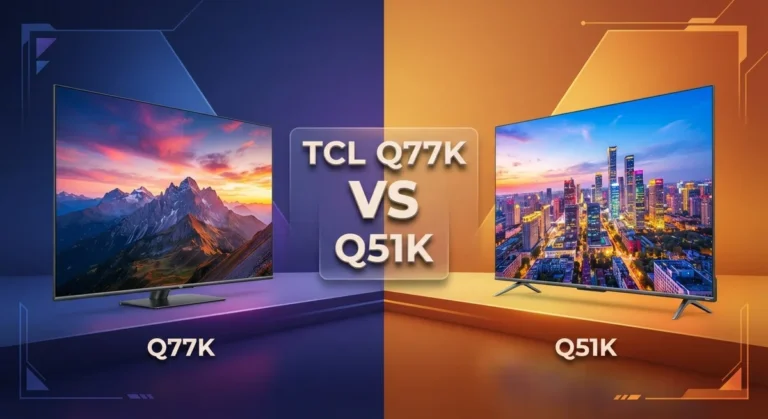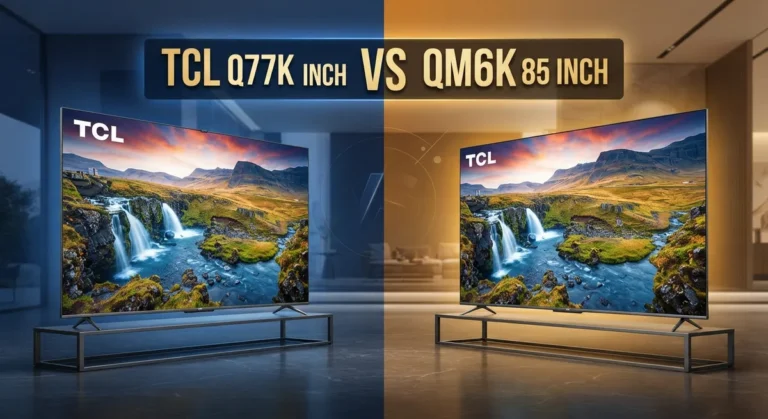

TCL Q77K vs QM6L: Performance vs Picture Quality Comparison
Picking a new TV can feel tricky. Two TCL models often land on shortlists: the Q77K and the QM6L.
Both promise great features, but they shine in different ways.
The Q77K brings gaming power to the table. It offers high refresh rates, low input lag, and support for VRR.
Gamers will notice the difference right away.
The QM6L takes a different path. It focuses on picture quality, delivering deep blacks and bright, accurate colors.
Movie nights and binge sessions look stunning on this screen.
So which TV fits your lifestyle? This guide breaks down every key spec, strength, and weakness.
You will find clear answers to help you choose the right TCL TV for your home.
Quick Comparison: TCL Q77K vs TCL QM6L
| Feature | TCL Q77K | TCL QM6L |
|---|---|---|
| Panel Type | QLED | QD-Mini LED, QLED |
| Sizes | 55″–85″ | Varies by model |
| Refresh Rate | 144Hz @4K/288Hz @1080p | 144Hz, Game Accelerator 288 |
| Local Dimming | Full-array local dimming | LD500 Precise Dimming zones |
| HDR Support | HDR10, Dolby Vision | HDR support (QLED-based) |
| Input Lag | 10–13ms | Low input lag (gaming-capable) |
| Picture Quality | Disappointing overall | Superior, deep uniform blacks |
| Viewing Angles | Decent viewing angles | Degrades at wide angles |
TCL Q77K Review

- 4K UltraHD Resolution: Experience incredible detail with 4X the resolution of 1080p Full HDTVs
- QLED (Quantum Dot Technology): Rich, vibrant colors covering nearly the entire DCI-P3 color space to bring images to...
- 120Hz Panel Refresh Rate: Watch action-packed movies, fast-paced video games, and live sports with an ultra-smooth...

Last update on 2026-10-13 / Affiliate links / Images from Amazon Product Advertising API
The TCL Q77K is a 4K gaming TV that packs impressive refresh rates and low input lag into a straightforward design. It comes in sizes from 55″ to 85″, making it flexible for different room setups.
This model shines for competitive gamers and esports fans. The 144Hz refresh rate at 4K and 288Hz at 1080p keep motion smooth, while the 10–13ms input lag gives you the response speed you need in fast-paced games.
The TV uses full-array local dimming with HDR10 and Dolby Vision support, which helps with contrast and color range. You’ll also get HDMI 2.1 and VRR (Variable Refresh Rate) for seamless gaming across PlayStation, Xbox, and PC.
Real-world viewing reveals some trade-offs. The screen handles gaming beautifully, but motion blur appears at 60Hz standard content, and the mirror-like surface creates noticeable glare in bright rooms.
Picture quality lags behind higher-end models, though the feature set punches above its class.
Pros
- Excellent gaming performance with low input lag and high refresh rates
- Full-array local dimming improves contrast and depth
- Fantastic format support across gaming platforms
- Decent viewing angles for a mainstream TV
Cons
- Motion blur visible during standard 60Hz content
- Glossy screen causes significant reflections and glare
- Overall picture quality trails behind premium competitors
TCL QM6L Review

- QD-MINI LED | BRIGHT WHERE IT SHOULD BE, DARK WHERE IT SHOULDN'T: Get the deep blacks and precise contrast shoppers...
- NATIVE 144Hz | BUILT FOR GAMING + SPORTS: Looking for a gaming TV or a better TV for sports? Native 144Hz, Motion Rate...
- ONKYO 2.1 + BUILT-IN SUBWOOFER | HOME THEATER SOUND: Turn your living room into a home theater with Onkyo 2.1 audio and...
Last update on 2026-10-13 / Affiliate links / Images from Amazon Product Advertising API
The TCL QM6L is a QD-Mini LED TV built for viewers who demand superior picture quality over gaming bells and whistles. This model sits in TCL’s entry-level premium range and appeals to anyone who spends more time watching movies and shows than chasing frame rates.
The standout feature is its LD500 Precise Dimming zones, which deliver deep, uniform blacks without the blooming that plagues cheaper sets. Colors pop with real vibrancy, and the HVA panel maintains excellent uniformity across the screen, making every seat in your room look great.
Real-world use shows this TV excels in bright living rooms where glare kills most displays. The AIPQ Processor sharpens upscaled content, and shadow detail stays crisp even in dark scenes.
Build quality feels solid, and the design keeps things simple without unnecessary clutter.
The trade-off is viewing angles—step to the side, and contrast drops noticeably. It also lacks some advanced gaming features the Q77K offers, though 144Hz refresh rate and Game Accelerator 288 still handle casual gaming well.
Pros
- Deep blacks and minimal blooming from LD500 dimming zones
- Bright, vibrant colors with excellent screen uniformity
- Strong shadow detail and upscaling performance
- Handles bright rooms without washout
Cons
- Image quality degrades rapidly at wide viewing angles
- Limited gaming features compared to higher-end models
- Entry-level positioning means fewer advanced options
Head to Head: Key Differences
The Q77K and QM6L serve two distinct viewing priorities. The Q77K targets gamers who want speed and responsiveness, while the QM6L focuses on visual richness for everyday watching.
Gaming performance separates these two clearly. The Q77K delivers 144Hz at 4K and 288Hz at 1080p with input lag between 10 and 13ms, making it ideal for fast-paced titles.
The QM6L matches the 144Hz refresh rate but doesn’t prioritize the ultra-high frame rates that competitive players demand.
Picture quality is where the QM6L pulls ahead significantly. Its LD500 Precise Dimming zones create deep blacks with minimal blooming, while the Q77K struggles with overall image fidelity despite its full-array local dimming system.
The QM6L’s brightness handles well-lit rooms better than the Q77K. If your living room gets plenty of natural light, the QM6L maintains color accuracy and contrast where the Q77K would wash out or show glare issues.
Viewing angles tell a different story. The Q77K offers decent side viewing, but the QM6L’s VA panel drops contrast quickly when you step away from center.
This matters if your couch isn’t directly in front of the screen.
Color and uniformity favor the QM6L decisively. Its QD-Mini LED technology produces vibrant, consistent colors across the entire screen.
The Q77K’s color performance feels flat by comparison.
Motion handling reveals the Q77K’s weakness. At 60Hz standard content, motion blur becomes noticeable.
The QM6L handles standard frame rates more smoothly.
Choose the Q77K if gaming dominance matters most. Pick the QM6L if you want a TV that looks exceptional for movies, shows, and everyday content in a bright space.
Which One Should You Buy
The TCL QM6L is the overall winner in this matchup.
It delivers deep, uniform blacks with minimal blooming and excellent shadow detail. Picture quality stands out as its biggest strength.
The QM6L also holds its own for gaming, with a 144Hz refresh rate that keeps things smooth.
Best for each buyer
-
TCL Q77K: Gamers who want low input lag, high refresh rates, and strong format support in one feature-rich package.
-
TCL QM6L: Buyers who want superior picture quality, deep uniform blacks, and great performance in bright rooms.
Frequently Asked Questions
Which TV has better picture quality overall?
The QM6L wins decisively here. Its QD-Mini LED technology with LD500 Precise Dimming zones produces deep, uniform blacks without blooming.
Colors appear vibrant and uniform across the screen. The Q77K’s picture quality feels flat and disappointing by comparison, especially in darker scenes.
The QM6L’s HVA panel delivers 1200:1 native contrast, which translates to better shadow detail and more lifelike images.
Should I choose the Q77K if I’m a competitive gamer?
Yes, the Q77K is built for gaming. It offers 144Hz at 4K and 288Hz at 1080p, plus low input lag between 10–13ms.
VRR support keeps gameplay smooth during fast action.
The QM6L matches the 144Hz refresh rate but doesn’t push ultra-high frame rates like the Q77K does. If you play fast-paced shooters or racing games, the Q77K’s specs give you an edge.
Which TV performs better in bright rooms?
The QM6L handles bright rooms much better. It delivers enough brightness to cut through glare and maintain picture quality even with windows and lamps nearby.
The Q77K struggles with reflections and glare due to its mirror-like screen surface.
If your living room gets lots of natural light, the QM6L is the smarter choice.
What’s the main weakness of each TV?
The Q77K suffers from motion blur at 60Hz and disappointing overall picture quality. Its reflective screen also causes annoying glare.
The QM6L’s viewing angles degrade rapidly. Step to the side of the couch, and contrast drops noticeably.
This matters only if multiple people watch from different positions.

Tian is a passionate technology enthusiast and reviewer who explores the latest in AI tools, gadgets, and digital innovations to help readers make informed tech decisions.