TCL Q77K vs Hisense U6QF: Performance, Brightness & HDR
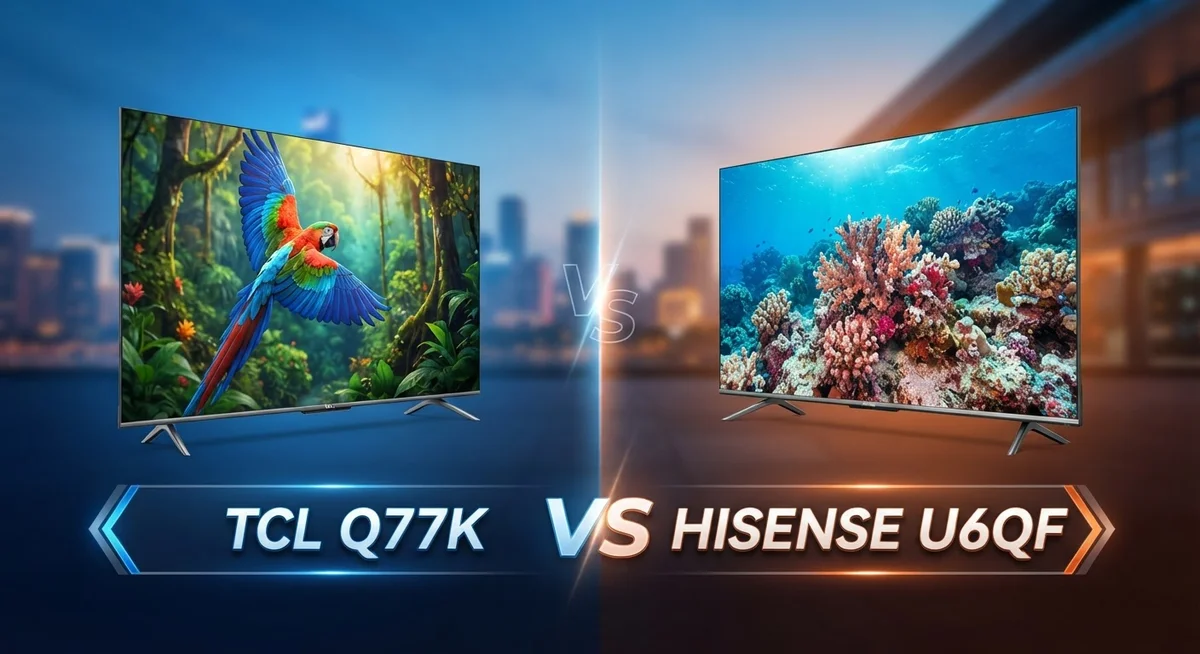
Picking a new TV can feel tricky. Two models often show up on shopping lists: the TCL Q77K and the Hisense U6QF.
Both promise great pictures, but they take different paths to get there.
The TCL Q77K stands out for gamers. It offers low input lag and smooth motion, plus support for many sizes.
This makes it a solid pick for fast-paced play and flexible room setups.
The Hisense U6QF takes a different approach. It uses Mini-LED backlighting to boost brightness and contrast.
This gives it an edge in bright rooms and helps HDR content pop.
So which TV fits your needs best? This guide breaks down specs, strengths, and weaknesses for each model.
By the end, you will know exactly which TV deserves a spot in your living room.
Quick Comparison: TCL Q77K vs Hisense U6QF
| Feature | TCL Q77K | Hisense U6QF |
|---|---|---|
| Screen Sizes | 55″-98″ | 65″ class |
| Refresh Rate | 288Hz@1080p/144Hz@4K | 144Hz @ 4K |
| Backlighting | Full-array local dimming | Mini-LED |
| HDR Support | HDR10, Dolby Vision | Dolby Vision, HDR10+ |
| Input Lag | 10-13ms | Not specified (Game Mode Pro) |
| Peak Brightness | Not specified | 450 cd/m² |
| Contrast Ratio | Not specified | 5000:1 |
| Best Use Case | Competitive gaming | Bright room HDR viewing |
TCL Q77K Review

- 4K UltraHD Resolution: Experience incredible detail with 4X the resolution of 1080p Full HDTVs
- QLED (Quantum Dot Technology): Rich, vibrant colors covering nearly the entire DCI-P3 color space to bring images to...
- 144Hz Panel Refresh Rate: Watch action-packed movies, fast-paced video games, and live sports with an ultra-smooth...

Last update on 2026-09-13 / Affiliate links / Images from Amazon Product Advertising API
The TCL Q77K is a full-array local dimming TV built for gamers who want low input lag and smooth motion without compromise. It comes in sizes from 55″ all the way to 98″, so you can fit it in almost any room.
This model shines with 288Hz refresh rate at 1080p and 144Hz at 4K, both with VRR support. You get HDMI 2.1 connectivity, HDR10 and Dolby Vision, plus fantastic format support that handles almost any content you throw at it.
The picture quality holds up well for both gaming and movies. Black levels stay deep, and viewing angles remain consistent even from the sides.
Motion performance feels smooth, and HDR accuracy impresses for the class.
Build quality feels solid, and the TV handles fast-paced gaming with input lag between 10–13ms. Real-world performance proves reliable for competitive play and everyday entertainment alike.
Pros
- Low input lag (10-13ms) and high refresh rates make competitive gaming buttery smooth
- Available in multiple sizes (55″ to 98″) for any room layout
- Strong HDR accuracy and excellent black level performance
- Supports a wide range of formats and codecs for maximum compatibility
Cons
- Motion blur becomes noticeable at 60Hz content
- Direct reflections and glare can wash out the picture in bright rooms
- Some users report inconsistent picture quality across units
Hisense U6QF Review

- HI - QLED MINILED: Striking contrast and vivid, lifelike color put every scene in a new light. Whether it's a sunny...
- NATIVE 144HZ REFRESH RATE: Fast breaks, high-speed chases, live finales — every frame stays crisp and fluid, so the...
- BUILT-IN SUBWOOFER: Immersive deep bass from the built-in subwoofer pulls you into the heart of the moment, from the...
Last update on 2026-09-13 / Affiliate links / Images from Amazon Product Advertising API
The Hisense U6QF is a 65-inch Mini-LED TV built for viewers who want superior brightness and contrast in well-lit spaces. This model prioritizes HDR performance and picture quality over gaming features, making it ideal for movie lovers and content enthusiasts.
The standout feature is its Mini-LED backlighting system with hundreds of dimming zones that deliver exceptional contrast and black depth. You also get 450 cd/m² peak brightness, which means HDR content looks stunning even with sunlight streaming through your windows.
Connectivity includes two HDMI 2.1 ports with 144Hz @ 4K and VRR support for gaming, plus Dolby Vision and HDR10+ for premium streaming content. The TV handles DTS passthrough audio, giving you cinema-quality sound options.
Build quality feels premium, and the Game Mode Pro with integrated game bar adds gaming convenience without sacrificing the TV’s core strength—picture quality. Real-world performance shows excellent color accuracy and contrast that outperforms similarly-sized competitors.
Pros
- Mini-LED zones deliver outstanding contrast and deep blacks
- 450 cd/m² brightness dominates in bright rooms and makes HDR pop
- Dolby Vision and HDR10+ support elevates streaming content quality
- Game Mode Pro adds gaming features without compromising picture excellence
Cons
- Limited to 65-inch size (no smaller or larger options available)
- Fewer video format options compared to other premium models
Head to Head: Key Differences
The TCL Q77K and Hisense U6QF take opposite routes to deliver great picture quality. One prioritizes gaming speed and flexibility, while the other focuses on brightness and contrast in bright spaces.
The Q77K gives you more size options. You can pick from 55 inches all the way to 98 inches, so any room works.
The U6QF stays locked at 65 inches, which limits placement choices for smaller or larger spaces.
When it comes to gaming, the TCL pulls ahead with its 10 to 13 millisecond input lag. This means your controller inputs hit the screen faster, making competitive games feel snappier.
The Hisense still supports 144Hz at 4K with VRR, but the slightly higher lag matters for serious gamers.
The Hisense U6QF shines in bright rooms where sunlight floods in. Its 450 cd/m² brightness crushes the TCL’s output, so HDR content pops without washing out.
The Mini-LED dimming system also delivers superior contrast and deeper blacks compared to full array local dimming.
Format support differs too. The Q77K handles more audio and video formats, making it better for collectors and enthusiasts.
The U6QF focuses on mainstream content like Dolby Vision and HDR10 plus.
Picture quality leans different between them. The TCL excels at motion smoothness and black levels for movies.
The Hisense wins on color accuracy and brightness for HDR films in lit rooms.
Your choice depends on your setup. Pick the Q77K if you game often, want size flexibility, and watch in dim rooms.
Choose the U6QF if you sit in bright spaces and prioritize stunning contrast with HDR content.
Which One Should You Buy
The TCL Q77K takes the win in this matchup. It delivers broader size options, lower input lag, and stronger gaming performance overall.
Its excellent format support and motion handling make it a versatile pick for most living rooms.
The Hisense U6QF still holds its ground for a specific type of viewer. It shines in bright spaces with strong contrast and HDR accuracy.
Best for each buyer
- TCL Q77K: Best for competitive gamers and buyers who want flexible screen sizes with strong motion handling and low input lag.
- Hisense U6QF: Best for viewers in bright rooms who prioritize peak brightness, contrast, and HDR accuracy over gaming features.
Frequently Asked Questions
Which TV handles fast action better without blur?
The TCL Q77K delivers smoother motion at 60Hz playback. It excels when you watch sports or action movies on standard frame rates.
The Hisense U6QF performs well but shows more motion blur at lower refresh rates. If fast-moving content matters to you, the Q77K wins this round.
Both support 144Hz at 4K with VRR for gaming. The difference shows up in everyday TV watching, not just games.
Can I use either TV in a very bright room?
The Hisense U6QF is your clear winner here. Its 450 cd/m² brightness cuts through sunlight and glare effectively.
The TCL Q77K struggles with direct reflections and bright environments.
Choose the U6QF if windows flood your room with natural light. The Mini-LED zones also help combat glare better than full-array dimming.
What if I need a specific screen size?
The TCL Q77K offers 55″, 65″, 75″, 85″, and 98″ options. You get flexibility for any space.
The Hisense U6QF comes only in 65″ class size.
The Q77K works better if you have unusual room dimensions or prefer a smaller or larger screen.
Which TV shows deeper blacks and better contrast?
The Hisense U6QF’s Mini-LED system creates superior contrast. Hundreds of dimming zones deliver deeper blacks and punchier highlights than the Q77K’s full-array approach.
The TCL still offers good black levels, but the U6QF pulls ahead for contrast-heavy content like movies and documentaries.
Do both TVs support the same gaming features?
The TCL Q77K has lower input lag (10-13ms), making it faster for competitive gaming. The Hisense U6QF includes Game Mode Pro with an integrated game bar for convenience.
Both support 144Hz at 4K with VRR. Pick the Q77K for pure speed or the U6QF for feature-rich gaming extras.

Tian is a passionate technology enthusiast and reviewer who explores the latest in AI tools, gadgets, and digital innovations to help readers make informed tech decisions.