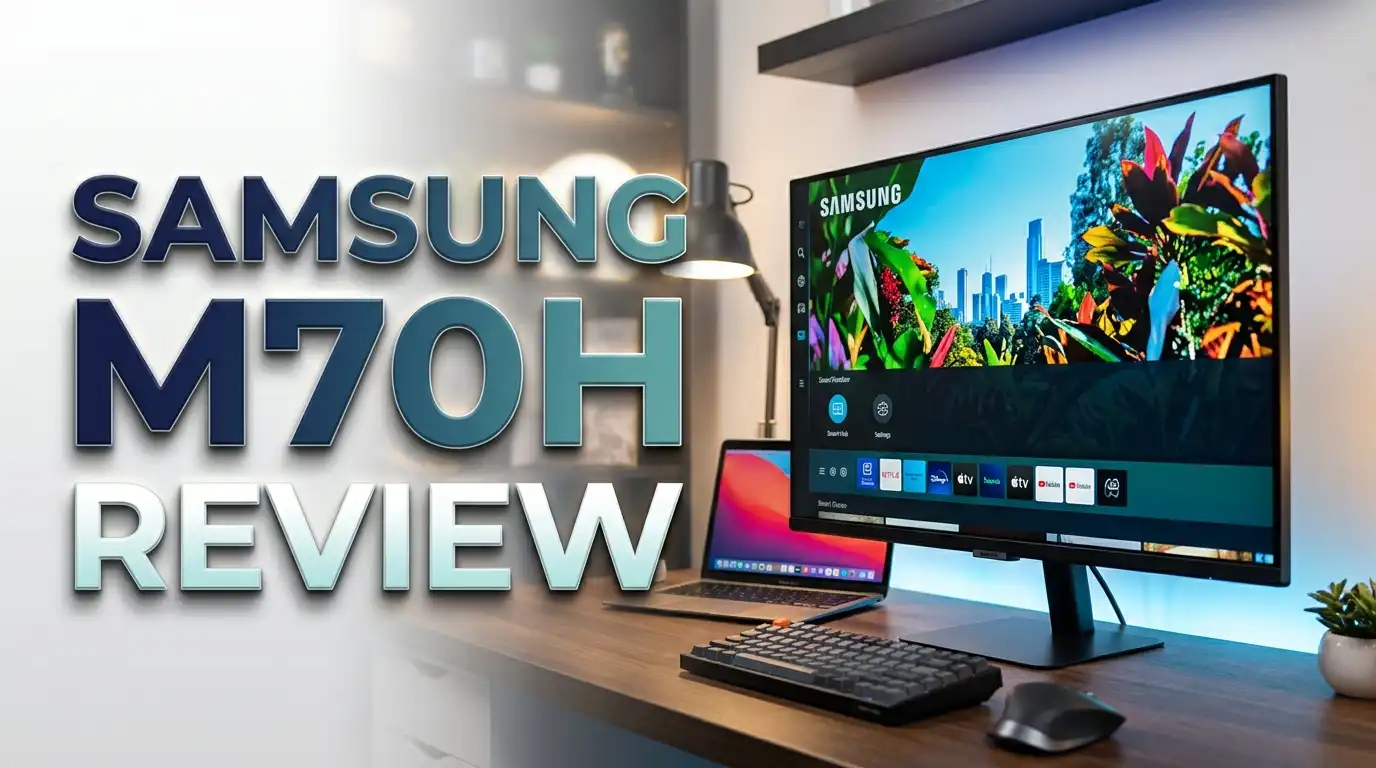
Samsung M70H Review 2026: Mini LED 4K TV Worth Buying?
The Samsung M70H landed in 2026 as the brand’s most affordable Mini LED TV. It promises bright highlights, deep blacks, and 4K clarity at a price that won’t drain your wallet. Many buyers want to know if this entry level model holds up against pricier rivals. This review breaks down every important feature in plain language.
You will learn about the picture, sound, smart platform, gaming chops, and real world value. We also share three strong alternatives in case the M70H does not fit your needs. By the end, you will know exactly whether this TV deserves a spot in your living room.
In a Nutshell
Here are the most important points before we dive deeper.
- Mini LED at a budget price: The M70H brings Mini LED backlight technology to Samsung’s lower tier, which usually means brighter highlights and richer contrast than basic LED sets.
- 4K resolution with HDR10+ support: You get sharp 3840 x 2160 visuals plus Samsung’s preferred HDR format for more vivid colors and detail in compatible content.
- Six size options from 43 to 85 inches: The M70H gives you flexibility for any room, from a small bedroom to a large family space.
- 60Hz native refresh rate with DLG 120Hz: Casual gamers will be fine, but competitive players may want a faster panel like the M80H.
- Tizen smart platform with Samsung Vision AI: You get AI upscaling, voice control, and access to every major streaming app right out of the box.
- Great value for everyday viewing: The M70H is best for movie nights, sports, and streaming, not pro level gaming or reference grade picture quality.
What Is the Samsung M70H?

- MINI LED PROCESSOR 4K: Our advanced processor delivers brighter highlights and deeper blacks,* bringing every detail to...
- PURE COLOR SPECTRUM: delivers one billion true-to-life colors, powered by advanced color technology and MiniLED...
- MINI LED HDR: Experience HDR picture quality with brighter highlights and deeper blacks than traditional HDR TVs.* Enjoy...
Last update on 2026-09-18 / Affiliate links / Images from Amazon Product Advertising API
The Samsung M70H is a 2026 model 4K Mini LED smart TV. It sits in Samsung’s lineup right above the Crystal UHD sets and just below the M80H. Samsung positions it as the entry point into Mini LED technology for shoppers who want better contrast without paying flagship prices.
The TV uses a Mini LED backlight system paired with Samsung’s standard processor. Mini LED means smaller, more numerous backlight zones, which usually improves brightness and black levels compared to old school LED. Samsung also adds its Pure Spectrum Color tech for wider color coverage.
You get a slim design with thin bezels and a matte finish. The stand keeps the set steady on most media consoles, and there are standard VESA mounts on the back. Samsung also includes the SolarCell remote, which charges from indoor light and saves you from buying batteries.
The M70H targets families, casual gamers, and movie fans who want a clean upgrade over basic LCD sets. It is not built to chase the Sony Bravia 9 or LG OLEDs. Instead, it competes directly with the Hisense U6 and TCL QM6K in the mid budget space.
Design and Build Quality
The M70H keeps things simple and modern. Samsung gave it a slim profile, narrow bezels, and a clean back panel. The whole TV feels lightweight for its size, which makes wall mounting much easier than with older heavy LCDs.
The stand uses two wide set feet. This works fine on large media stands but may be a problem on smaller furniture. Buyers with narrow TV consoles should measure before ordering, especially for the 65 inch and larger models.
Build quality matches what you expect from Samsung at this price. The plastics feel solid, the panel sits flush, and nothing creaks or flexes. The matte finish on the rear hides fingerprints well, which helps if you plan to wall mount it.
Cable management is basic but workable. The ports sit in a side facing recess, which makes flush mounting cleaner than rear facing setups. You will not find the One Connect Box here, since that feature is reserved for higher end Neo QLED models.
Color options are limited to a single black finish. The bezel is thin enough that it almost disappears during viewing. Overall, the M70H looks much more expensive than it actually is, and that is a real win for budget shoppers.
Picture Quality and Mini LED Performance
The Mini LED panel is the headline feature of the M70H. Samsung uses smaller LEDs in the backlight to boost peak brightness and improve contrast. In real world viewing, the M70H delivers punchy highlights and decent black levels for its price class.
Colors look vibrant thanks to Pure Spectrum Color. Skin tones stay natural, and bright scenes pop without looking cartoonish. The 4K resolution keeps fine detail crisp, especially in nature documentaries and modern streaming content.
That said, the local dimming on the M70H is software based rather than full array. This means you may notice some blooming around bright objects on dark backgrounds. Casual viewers will not care, but picture purists will spot the difference against the M80H or higher end Mini LED sets.
HDR support covers HDR10, HDR10+, and HLG. Dolby Vision is not included, which is a common Samsung limitation. Most streaming content still looks great, but Dolby Vision fans on Netflix or Disney Plus will miss that extra polish.
Viewing angles are typical for a VA style panel. Colors and contrast shift if you sit far off center. Place the TV facing your main seating spot and you will be happy with what you see.
Audio Quality and Sound Features
The M70H ships with a 2 channel speaker system rated at 20 watts. It does the job for news, sitcoms, and casual streaming. Dialogue stays clear, and the volume gets loud enough to fill a medium sized living room.
Bass is the obvious weak point. Action movies and music feel thin without a soundbar. This is true of almost every modern slim TV, not just the M70H. Samsung makes the slim design possible by cutting speaker space.
The good news is Samsung includes Object Tracking Sound Lite. This feature places audio to match on screen action, so cars sound like they move across the room. It adds a layer of immersion that older budget TVs lacked.
Q Symphony is also onboard. If you own a compatible Samsung soundbar, the TV speakers and soundbar play together rather than shutting off. This expands the sound stage and makes movies feel more cinematic.
For the best experience, plan to pair the M70H with a basic soundbar. Even a budget model in the 150 dollar range transforms the audio. Without one, expect TV grade sound that works but never wows.
Smart TV Features and Tizen OS
The M70H runs Samsung’s Tizen platform with Samsung Vision AI. The interface is fast, clean, and packed with every major streaming app you might want. Netflix, Disney Plus, Max, Apple TV, Prime Video, YouTube, and Peacock all run smoothly.
Samsung Vision AI adds smart upscaling, sound optimization, and Bixby voice control. The AI upscaler does a decent job cleaning up older 1080p shows. You also get Live Translation, which can translate subtitles in real time for foreign content.
The Quick Remote feature turns your Samsung phone into a TV remote. Note that the M70H is more limited than the M80H here. It does not include the full SmartThings Hub or IoT sensor control, so smart home fans should look at the M80H instead.
You also get free Samsung TV Plus, which adds hundreds of ad supported live channels. This is great for casual background viewing or for kids’ shows. The Gaming Hub also lets you stream cloud games from services like Xbox without a console.
Tizen does show some ads on the home screen. This is annoying but typical of every smart TV in 2026. You can disable most personalized ads in the settings menu if it bothers you.
Top 3 Alternatives for Samsung M70H
If the M70H is not quite the right fit, here are three strong alternatives worth a serious look.

- MINI LED WITH AI MODE: Mini LED with AI Mode combines compact, high-efficiency Mini LEDs with intelligent processing for...
- MOTION XCELERATOR 144HZ: Get the edge in fast-paced games and sports with ultra-smooth 144Hz performance.* Variable...
- PURE SPECTRUM COLOR: Pure Color Spectrum delivers one billion true-to-life colors, powered by advanced color technology...

Last update on 2026-09-06 / Affiliate links / Images from Amazon Product Advertising API

- Mini-LED Pro With Up to 3000 Local Dimming Zones And Up to 3000 nits Peak Brightness: See the realism of every shadow...
- Native 165Hz Panel With Game Booster 288: Turbo power your gaming! The Native 165Hz Panel has a Variable Refresh Rate of...
- Enhanced Game Bar: Enjoy your gaming dashboard and manage performance in real time. Seamlessly adjust settings and...
Last update on 2026-09-13 / Affiliate links / Images from Amazon Product Advertising API

- TCL QM6K QD-MINI LED TV SERIES - AFFORDABLE PREMIUM PERFORMANCE FOR SPORTS, GAMING & STREAMING. Experience superior...
- QD-MINI LED. IT’S MINI LED PLUS QLED COLOR - BREATHTAKING BRIGHTNESS AND COLOR IN ANY LIGHT. Combines ultra-precise...
- TCL HALO CONTROL SYSTEM - BETTER BLACKS. SHARPER DETAIL. NO BLOOMING. Advanced local dimming eliminates haloing...
Last update on 2026-09-13 / Affiliate links / Images from Amazon Product Advertising API
The Samsung M80H is the obvious step up. It adds a 144Hz refresh rate, a better NQ4 AI Gen2 processor, full SmartThings Hub, and AI Auto Game Mode for serious gaming. It costs more but adds real value if you want longer term performance.
The Hisense U7QG is a hot pick for buyers who want more brightness and faster gaming. It hits around 3000 nits of peak brightness, supports 165Hz native, and includes Dolby Vision IQ. It is the best Mini LED for gaming in the mid range space.
The TCL QM6K is another great Mini LED competitor. It runs Google TV instead of Tizen, supports 144Hz at 4K, and offers Dolby Vision support. It usually undercuts Samsung on price while matching most picture quality boxes.
Gaming Performance on the M70H
The M70H is a fine TV for casual gaming. Input lag stays low in Game Mode, and the picture stays sharp during fast paced action. The Gaming Hub gives you cloud gaming without a console, which is great for younger family members.
The catch is the 60Hz native refresh rate. Samsung advertises DLG 120Hz, which means it can accept a 120Hz signal at lower resolutions through backlight tricks. Real native 120Hz at 4K is not supported here. Competitive players who own a PS5 Pro or Xbox Series X will feel limited.
VRR support is included, which reduces screen tearing in compatible games. ALLM also kicks in automatically when your console signals it. These features keep gaming smooth for the average player.
The HDMI ports are HDMI 2.0, not 2.1. This is the main limitation for next gen gamers. You cannot push 4K at 120Hz to this set. If that is a deal breaker, the M80H or Hisense U7QG are better picks.
For most living room gaming, the M70H works fine. Single player adventures, racing games, and sports titles all look great. Just do not expect esports level performance from a budget Mini LED in 2026.
Connectivity and Ports
The M70H gives you a reasonable port selection for the price. You get three HDMI inputs, two USB ports, an optical audio output, an Ethernet jack, and a coaxial connector for an over the air antenna.
The HDMI ports support eARC on one input. This is important if you plan to connect a soundbar or AV receiver. eARC carries lossless audio formats like Dolby Atmos, which makes a big difference for movie nights.
Wi Fi 5 and Bluetooth 5.2 round out the wireless connections. The TV connects to your home network without trouble and pairs easily with Bluetooth headphones. AirPlay 2 is also supported for Apple device owners.
The lack of HDMI 2.1 is the obvious downside. You cannot push 4K at 120Hz from a console, and features like Quick Frame Transport are missing. This is a clear cost cutting move by Samsung to keep the price competitive.
Three HDMI ports should still cover most setups. A console, a streaming stick, and a soundbar can all plug in at once. Heavy users with many devices may want to add an HDMI switch later.
Energy Efficiency and Day to Day Use
The M70H earns decent marks for energy use. Samsung includes Eco Mode, which dims the backlight to reduce power draw. This saves money on your electricity bill without ruining the picture for daytime viewing.
The auto brightness sensor adjusts the screen based on room lighting. Bright rooms get a punchier image, while dark rooms dim down to protect your eyes. This works smoothly and keeps the picture comfortable around the clock.
Boot up time is fast. The TV wakes from standby in about two seconds, which feels quick compared to older smart TVs. The interface stays responsive even after months of use, since Samsung’s Tizen runs well on this hardware.
The SolarCell remote is a nice touch. It charges through indoor light or USB C, which means you will likely never need to replace batteries. This is a small but welcome quality of life feature.
Heat output is minimal during normal use. The TV stays cool to the touch even after long viewing sessions. Reliability should be solid given Samsung’s track record with mid range sets.
Who Should Buy the Samsung M70H?
The M70H is best for buyers who want a clear upgrade from old basic LED TVs without paying flagship prices. Families, dorm room shoppers, and bedroom TV buyers will find it a great fit. It nails the basics of 4K streaming and casual sports viewing.
Pick the smaller 43 or 50 inch models for a kitchen, office, or guest room. Choose the 65 or 75 inch for the main living space. The 85 inch suits buyers with large viewing distances and bigger budgets.
Skip the M70H if you are a competitive gamer who needs 4K at 120Hz. The lack of HDMI 2.1 and the 60Hz panel will frustrate you. The M80H or Hisense U7QG are smarter picks for serious gaming.
Also skip it if you want true reference picture quality. The software based local dimming cannot match higher end Mini LED sets with full array zones. Picture purists should save up for a Neo QLED or OLED instead.
For everyone else, the M70H punches above its price tag. It looks great, sounds decent, and runs a smooth smart platform. Most buyers will be happy for years.
Samsung M70H Pros and Cons
Here are the strong points and weak points in one clear glance.
Pros:
- Mini LED backlight delivers better contrast than basic LED sets
- Bright, vivid colors with Pure Spectrum Color tech
- Six size choices from 43 to 85 inches
- Smooth Tizen smart platform with all major apps
- SolarCell remote that never needs batteries
- Great value at the price point
Cons:
- 60Hz native refresh rate limits gaming
- No HDMI 2.1 or 4K at 120Hz
- Software based local dimming can show blooming
- No Dolby Vision support
- Built in speakers lack bass
- Limited smart home features compared to M80H
This balance shows the M70H knows what it is. It chases value, not perfection. If you understand the trade offs, you will be happy with the result.
Samsung M70H vs M80H Comparison
The M70H and M80H share the same Mini LED foundation but split on key features. The M70H costs less and offers more size options, including 43 and 50 inch models that the M80H lacks.
The M80H steps up with a 144Hz native refresh rate, the NQ4 AI Gen2 processor, full SmartThings Hub, and AI Auto Game Mode. It also adds Active Voice Amplifier Pro for clearer dialogue and Pet Care features for animal lovers.
Both TVs share HDR10+, Samsung Vision AI, Q Symphony, and Object Tracking Sound Lite. Picture quality differences are small but real, with the M80H pulling slightly ahead in brightness and motion handling.
Pick the M70H if you want the cheapest Mini LED Samsung makes in 2026. Pick the M80H if gaming, smart home, or future proofing matters more than saving 200 dollars. Both are solid choices for their target buyers.
Final Verdict on the Samsung M70H
The Samsung M70H is a smart buy for budget shoppers who want Mini LED quality without overspending. It nails the basics, looks sharp, and runs a clean smart platform. The picture quality easily beats basic LED sets in the same price range.
The trade offs are real but expected. You give up 4K at 120Hz, full array local dimming, and Dolby Vision. In return, you get a great looking 4K TV that handles streaming, sports, and casual gaming with ease.
For families, dorm rooms, kitchens, and second TVs, the M70H is one of the best deals of 2026. It punches above its weight, especially in the 43 and 50 inch sizes where rivals struggle to match the Mini LED tech.
If you want more gaming muscle or a richer smart home ecosystem, step up to the M80H. If you want maximum brightness, look at the Hisense U7QG. For everyone else, the M70H deserves a strong recommendation.
Frequently Asked Questions
Is the Samsung M70H worth buying in 2026?
Yes, the M70H is worth buying for most casual viewers. It offers Mini LED picture quality at a budget price, plus six size options and a smooth smart platform. Heavy gamers and picture purists should look at higher tier sets instead.
Does the Samsung M70H support 4K at 120Hz?
No, the M70H has a 60Hz native panel and uses HDMI 2.0 ports. It supports DLG 120Hz at lower resolutions but cannot accept true 4K at 120Hz. Serious gamers should pick the M80H or Hisense U7QG for full 120Hz performance.
What sizes does the Samsung M70H come in?
The M70H comes in 43, 50, 55, 65, 75, and 85 inch sizes. This gives it more flexibility than the M80H, which skips the smaller 43 and 50 inch options. You can match the M70H to almost any room size.
Does the Samsung M70H support Dolby Vision?
No, the M70H does not support Dolby Vision. It does support HDR10, HDR10+, and HLG. Samsung has historically skipped Dolby Vision across its entire TV lineup, so this is not unique to the M70H.
Is the Samsung M70H good for gaming?
The M70H is fine for casual gaming. Input lag is low, VRR is supported, and the Gaming Hub adds cloud play. The 60Hz panel and HDMI 2.0 ports limit it for competitive 4K at 120Hz gaming on PS5 Pro and Xbox Series X.
How does the M70H compare to the Hisense U7QG?
The Hisense U7QG offers higher peak brightness, 165Hz native refresh, and Dolby Vision support. The M70H wins on smart platform polish and more size options. Pick the U7QG for gaming, pick the M70H for everyday family use.
Does the Samsung M70H need a soundbar?
The built in speakers handle basic viewing, but a soundbar is a smart upgrade. Bass is thin on the M70H without one, which is true of most slim modern TVs. Even a basic soundbar transforms the audio experience for movies and music.

Tian is a passionate technology enthusiast and reviewer who explores the latest in AI tools, gadgets, and digital innovations to help readers make informed tech decisions.