
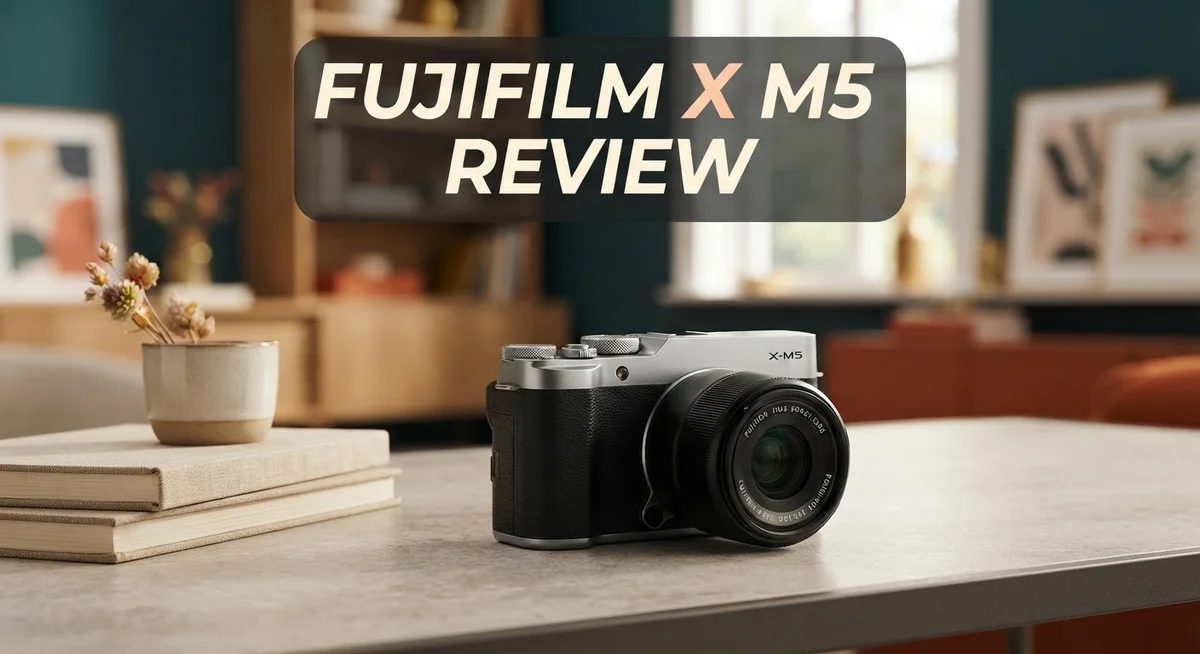
Fujifilm X-M5 Review: Compact APS-C Mirrorless Camera Worth It?
The Fujifilm X-M5 brings something fresh to the X Series lineup. This camera packs a punch in a tiny body. It feels like a perfect match for beginners and creators alike.
You get a 26.1MP APS-C sensor and 6.2K video in the smallest X Series model yet. The touchscreen interface replaces the traditional viewfinder setup. This shift makes the camera simple to use on the go.
Fujifilm fans love the brand’s film-like image quality. The X-M5 delivers natural highlight rolloff and smooth grain in low light. It brings that signature look to a compact, lightweight design.
Does this little camera compete with bigger rivals? Let’s explore what makes the X-M5 stand out. We will cover its strengths, its quirks, and who should pick one up.
In a Nutshell
Here is what you need to know about the Fujifilm X-M5 before diving deeper.
- Pocket sized powerhouse: This camera fits in your bag easily but still delivers serious image quality.
- No viewfinder included: You frame every shot through the touchscreen, which keeps things simple but different.
- Flash free design: Fujifilm skips the built in flash here, so you rely on natural light or external options.
- Touch first controls: The classic D-pad is gone. You now swipe and tap to adjust settings.
- Perfect for beginners: New photographers get creative freedom without a steep learning curve.
- Shines in low light: Night shots look clean with smooth grain instead of harsh noise.
- Stands apart from rivals: Unlike the X100VI or Ricoh GR III, this model lets you swap lenses freely.
This camera blends simplicity with genuine creative power. It is a solid pick for anyone who wants Fujifilm’s signature look in a smaller package. The X-M5 proves good things really do come in small sizes.
Key Features and Specifications
The Fujifilm X-M5 packs impressive hardware into a frame that weighs just 405 grams. This makes it one of the lightest options in the X Series lineup, perfect for photographers who want serious capability without the bulk.
At its core sits a 26.1MP APS-C sensor that captures stunning detail across a wide range of lighting situations. The sensor uses Fujifilm’s proven technology to deliver natural color rendition and smooth tonal transitions. You get 6.2K video recording as well, which opens creative doors for filmmakers and vloggers who want high resolution footage.
The camera uses an interchangeable lens system, so you can swap lenses to match your shooting style. This flexibility means you’re not locked into one focal length. The kit includes the XC 15-45mm lens, which covers wide to short telephoto ranges for everyday photography.
One key design choice sets the X-M5 apart: no electronic viewfinder. Instead, you frame every shot on the touchscreen display. This keeps the body compact and simple, though it requires adjustment if you’re used to traditional viewfinders. The touchscreen interface lets you tap to focus, swipe to adjust settings, and navigate menus with your fingers.
The touch first controls represent a shift from older X Series models. Fujifilm removed the traditional D-pad, making the camera feel more modern and streamlined. This approach works especially well for beginners who find physical buttons intimidating.
Another notable absence is the built-in flash. You’ll rely on natural light or invest in an external flash unit if you need fill light. This design choice saves weight and keeps costs down.
The sensor excels in low light situations, producing clean night shots with smooth grain rather than harsh digital noise. Colors remain accurate even when you push the ISO higher. This performance makes the X-M5 reliable for indoor events, evening photography, and creative night work.
Overall, the X-M5 combines a powerful sensor, compact size, and beginner-friendly controls into one cohesive package.

- This Digital Camera Bundle includes:
- FUJIFILM X-M5 Mirrorless Camera with XC 15-45mm f/3.5-5.6 Lens (USA Warranty)
- SanDisk 64GB Extreme PRO UHS-I SDXC Memory Card.
Last update on 2026-10-09 / Affiliate links / Images from Amazon Product Advertising API
Design and Build Quality
The Fujifilm X-M5 embraces a philosophy of simplicity meets capability. Its design strips away unnecessary elements to create a camera that feels approachable yet capable. The body measures just 121.7 x 83.5 x 49.2mm and weighs only 405 grams, making it genuinely pocket-friendly for daily carry.
The construction uses a magnesium alloy chassis paired with a polycarbonate top plate. This combination keeps the camera light without sacrificing durability. The grip sits naturally in your hand, even during extended shooting sessions. Fujifilm paid attention to ergonomics here.
What immediately strikes you is the absence of an electronic viewfinder. Instead, you frame shots entirely through the 3.5-inch touchscreen. This decision frees up internal space and reduces weight. The screen itself is bright and responsive, with good viewing angles for both horizontal and vertical compositions.
The touchscreen interface replaces the traditional D-pad found on other X Series models. Menu navigation happens through swipes and taps rather than button presses. This feels intuitive for smartphone users but requires adjustment if you’ve used older Fujifilm cameras. The touch controls extend to exposure compensation and focus point selection during live view.
Physical buttons remain for power, shutter, and video recording. These controls feel solid and responsive under your thumb. The shutter button has a satisfying half-press resistance that encourages deliberate shooting.
The camera lacks a built-in flash, which some may view as a limitation. However, this omission contributes to the compact profile. You can attach external flash units via the hot shoe if needed.
Material quality feels premium throughout. The textured surfaces provide good grip even with wet hands. Seals protect against dust and moisture, though this isn’t a fully weather sealed camera. The build suggests Fujifilm intended this for photographers who value portability without compromising on image quality.
The overall design philosophy prioritizes accessibility. Everything about the X-M5 communicates that this camera welcomes new photographers while offering enough depth for creative exploration. Form follows function without excess.
Image Quality and Sensor Performance
The Fujifilm X-M5 delivers exceptional image quality that punches well above its compact size. The 26.1MP APS-C sensor captures stunning detail and color accuracy that photographers genuinely love.
Colors pop with natural vibrancy straight from the camera. Fujifilm’s film simulation modes add creative flair without feeling artificial. Skin tones render beautifully, and landscapes show rich, authentic hues. The sensor’s dynamic range handles tricky lighting well, preserving detail in both shadows and highlights.
Low light performance stands out as a real strength. The camera produces clean night shots with smooth grain instead of harsh digital noise. ISO performance stays solid up to around 3200, making evening photography feel natural. You can push higher if needed, though grain becomes more visible.
Autofocus speed impresses for a compact camera. The system locks onto subjects quickly and tracks movement smoothly. Video shooters get 6.2K capability, which future proofs your footage. Frame rates and color science remain consistent with Fujifilm’s reputation.
The sensor handles motion well. Fast moving subjects stay sharp when you nail the focus. Continuous shooting reaches 7fps, letting you capture sequences without missing the moment.
One thing to understand: this camera prioritizes natural image rendering over aggressive processing. You won’t get punchy, oversaturated colors out of the box. Instead, you get honest representation that responds beautifully to post processing. Many photographers actually prefer this approach because it gives them control.
Macro capabilities work decently with compatible lenses. The touchscreen helps with precise focus point selection when shooting close subjects. Depth of field control feels intuitive through the lens selection.
The lack of in body stabilization matters for video and handheld shooting. Pairing the X-M5 with stabilized lenses helps tremendously. Still images rarely suffer since shutter speeds stay fast enough in good light.
Overall, the sensor performance justifies choosing this camera. Image quality remains consistent across different scenarios. Whether you shoot portraits, landscapes, or street scenes, the X-M5 delivers results that feel professional and satisfying.
Top 3 Alternatives
Sony Alpha A6400

- 20.1MP stacked back illuminated 1" Exmor RS CMOS sensor w/ DRAM, large aperture 24-70mm1 F1.8-2.8 ZEISS...
- Enhanced subject capture: wide 425 Phase/ 425 contrast detection points over 84 percent of the sensor
- Fast and accurate: Up to 11Fps continuous shooting at 24.2 MP raw with crisp, clear natural colors
Last update on 2026-10-13 / Affiliate links / Images from Amazon Product Advertising API
The Sony Alpha A6400 brings fast autofocus performance to your photography. This camera uses 425 phase-detection points that cover most of the frame. You get quick subject tracking that locks onto moving targets with ease.
The 24.2-megapixel sensor captures sharp images in various lighting conditions. Video recording reaches 4K resolution at 30fps, which works well for content creators. The compact body fits comfortably in your hands during extended shooting sessions.
Battery life reaches approximately 410 shots per charge. The camera connects wirelessly to your smartphone for instant image transfer. Real-time Eye AF keeps your subject’s eyes perfectly sharp, even during fast action.
Canon EOS M50 Mark II

- 24.1 megapixel (aps-c) cmos sensor with iso 100-25600 (h: 51200).
- Digic 8 image processor with auto lighting optimizer.
- Improved dual pixel cmos af and eye detection af (still/movie servo af support).
Last update on 2026-10-13 / Affiliate links / Images from Amazon Product Advertising API
The Canon EOS M50 Mark II offers excellent video capabilities for vloggers and filmmakers. Its 24.1-megapixel sensor produces clean images with accurate colors. The camera records 4K video at 24fps and includes a built-in microphone input for external audio.
The articulating touchscreen flips upward, making self-recording simple and convenient. Dual Pixel CMOS AF ensures smooth focus transitions during video work. You’ll appreciate the intuitive menu system that keeps settings easy to access.
Battery performance gives you around 305 shots per charge. The compact design makes this camera ideal for travel and everyday use. Built-in Wi-Fi allows quick sharing to social media platforms.
Nikon Z fc

- Superb image quality: 20.9 MP DX CMOS sensor paired with EXPEED 6 processing engine
- Vlogger Ready: 4K UHD, Flip out Vari-angle LCD, full time AF with eye detection, built-in stereo microphone...
- Heritage Design: Classic tactile design with analog controls for shutter speed, ISO and exposure compensation
Last update on 2026-10-28 / Affiliate links / Images from Amazon Product Advertising API
The Nikon Z fc brings retro styling with modern technology inside. Its 20.9-megapixel sensor delivers vibrant colors and good detail. The camera features fast and accurate autofocus with 209 focus points across the frame.
4K video recording reaches 30fps for smooth footage. The compact Z-mount system opens doors to future lens options. The camera weighs just 340 grams, making it extremely portable for travel photography.
Battery life provides approximately 300 shots per charge. The vari-angle screen rotates for flexible shooting angles. Built-in connectivity includes Bluetooth and Wi-Fi for seamless file transfer.
Video Capabilities and Recording
The Fujifilm X-M5 brings 6K video recording to a compact camera body that fits in your bag. This feature opens creative doors for content creators and filmmakers who want professional output without bulk.
Video recording happens through the touchscreen interface or the dedicated video button on the camera body. You can start filming with one tap or press. The camera supports various frame rates and resolutions to match different projects.
4K recording delivers smooth footage at standard frame rates. You get flexibility with 24p, 25p, and 30p options depending on your region and creative needs. The 6K capability pushes beyond standard 4K, capturing extra detail that gives you more freedom in post production editing.
One important detail: the X-M5 lacks in body stabilization. This means handheld video work requires steady hands or external support like tripods and gimbals. Pairing the camera with stabilized lenses helps reduce shake during filming.
Audio recording works through the built in microphone. External microphone support comes via a 3.5mm jack, which is helpful for interviews and professional sound work. You control audio levels through the touchscreen menu system.
The sensor’s low light strength carries over to video mode. Night scenes maintain clean footage without excessive noise. Colors stay natural and pleasing even in dim conditions.
Video autofocus performs well for a compact camera. The system tracks subjects smoothly during panning and movement. You can switch between autofocus modes or manually focus through the touchscreen.
File formats include H.264 and H.265 codec options. H.265 saves storage space while maintaining quality. Recording times depend on your memory card capacity and chosen resolution.
Battery life during video requires attention. Extended shooting sessions demand spare batteries or external power solutions. The camera consumes more power during video recording than still photography.
The X-M5 suits vloggers, travel filmmakers, and hybrid creators who shoot both stills and video. Its compact size makes it ideal for mobile content creation. The touchscreen controls adapt well to video work, letting you adjust settings while filming without moving your eye from the screen.
User Interface and Touchscreen Experience
The touchscreen on the X-M5 becomes your main control hub. You navigate menus, adjust settings, and compose shots all through this responsive display. The interface feels intuitive for beginners who already use smartphones.
Swiping and tapping replace the traditional button-based approach found on other Fujifilm cameras. This shift means you get faster access to frequently used functions. The screen responds quickly to your touch inputs without lag or frustration.
One key difference: the D-pad is completely gone. Instead, you rely on on-screen controls and touch gestures. This takes some adjustment if you’ve used other X Series models before. However, most users adapt within the first few shooting sessions.
The touchscreen also handles menu navigation smoothly. You scroll through options with familiar pinch and swipe motions. Text appears large and readable even in bright sunlight. The interface uses clear icons that communicate their purpose instantly.
Physical buttons remain where they matter most. The shutter button sits in the traditional spot. Power and video recording buttons stay on the camera body. This hybrid approach keeps essential controls tactile while embracing touch for everything else.
Autofocus selection becomes easier with the touchscreen. You tap directly on your subject, and the camera focuses there instantly. This focus-and-shoot simplicity appeals to photographers moving from smartphones to interchangeable lens cameras.
The display quality supports this touch-first design. Colors appear accurate, and contrast remains strong from various angles. You see exactly what the sensor captures before you press the shutter.
One consideration: glove operation becomes challenging during cold weather. The touchscreen requires bare skin contact to register inputs. This limitation matters if you shoot frequently in winter conditions.
Battery drain increases slightly with constant touchscreen use. The display consumes power throughout your shooting session. Planning for extra batteries makes sense during full day shoots.
Overall, the touchscreen interface prioritizes accessibility and speed. New photographers appreciate the familiar interaction model. Experienced users may initially miss physical buttons, but the system proves efficient once you understand the layout. The X-M5’s interface removes traditional barriers between you and creative image making.
Pros and Cons
Pros
- Compact size makes this the smallest X Series model, fitting easily into bags and travel kits
- Film-like color rendering delivers natural highlights and smooth grain in low light situations
- 26.1MP APS-C sensor produces sharp images with excellent detail retention across various lighting conditions
- Interchangeable lens system opens creative possibilities while maintaining portability
- Beginner-friendly interface paired with full manual controls for photographers ready to grow
Cons
- No electronic viewfinder means you rely entirely on the rear touchscreen for framing shots
- Touchscreen-heavy design removes the traditional D-pad, requiring adjustment if you’re coming from other Fujifilm cameras
- Missing built-in flash limits your options in dim indoor situations without external equipment
- Lack of in body stabilization affects handheld video and requires steady hands or a tripod for smooth footage
Who Should Buy It
The X-M5 works best for photographers who want to start their mirrorless journey without overwhelming complexity. Beginners benefit from the touchscreen interface, which feels natural if you’ve used a smartphone. You get full manual controls available whenever you’re ready to explore them.
Travel photographers love this camera because it’s the smallest X Series model. It fits into everyday bags without adding bulk. The compact design doesn’t sacrifice image quality or lens options. You can swap lenses based on your needs while staying light on your feet.
Content creators shooting for social media find the X-M5 appealing. The 6.2K video capability gives you flexibility in post-production. The film-like color rendering works well for lifestyle content and vlogs. The touchscreen makes menu navigation quick when you’re working fast.
Students and hobbyists appreciate having creative control without steep learning curves. The 26.1MP sensor captures excellent detail in various lighting situations. Low light performance delivers smooth grain instead of harsh noise. You can practice photography fundamentals and gradually master advanced techniques.
Photography enthusiasts upgrading from smartphones or compact cameras find the interchangeable lens system opens new creative doors. The natural highlight rolloff gives images a polished look. You’re not locked into one focal length, so you can experiment freely.
However, skip this camera if you absolutely need an electronic viewfinder. Some photographers feel uncomfortable composing entirely on a rear screen. Cold weather users might struggle with glove operation on the touchscreen. Professional videographers requiring in-body stabilization should look elsewhere.
The X-M5 also suits photographers who prefer Fujifilm’s film simulation modes. These built-in presets deliver consistent aesthetics without heavy editing. You can shoot confidently knowing your images will look cohesive.
Ultimately, the X-M5 targets people who value portability, simplicity, and image quality equally. It bridges the gap between casual smartphone photography and serious hobby work. The camera rewards curiosity while remaining forgiving enough for learning mistakes.
Final Verdict
The Fujifilm X-M5 earns its place as a strong choice for new mirrorless shooters. It blends simplicity with creative depth in a way few cameras manage.
Image quality stands out as the biggest strength here. Colors look natural. Grain stays smooth even in tricky light.
This camera rewards people who enjoy learning through doing. The touchscreen interface feels modern and welcoming. It never feels like a barrier to creativity.
Video capability adds real value too. 6.2K recording gives creators room to crop and edit without losing quality. This makes the X-M5 a solid pick for hybrid shooters who blend photos and video.
Some limitations exist and they matter. Shooters who depend on an electronic viewfinder will feel the absence. Bright outdoor sessions can make screen-only framing tricky at times.
The missing flash also changes how you approach certain shots. You will likely need external lighting solutions for low-light events or indoor gatherings.
Despite these gaps, the camera fits its intended audience well. New photographers get a tool that teaches without overwhelming. Experienced shooters get a lightweight backup body that still delivers Fujifilm’s signature look.
Social media creators will appreciate the portability most. The camera slips into daily life easily. It never feels like a burden during travel or casual outings.
Compared to rivals like the Ricoh GR III, the X-M5 offers more flexibility through its lens system. Fixed lens cameras cannot match that kind of growth potential.
The Fujifilm X100VI remains a tempting alternative for those wanting a built-in viewfinder. But the X-M5 wins on adaptability and lens choice.
In the end, this camera suits anyone ready to explore photography seriously. It does not try to be everything. It focuses on doing the essentials beautifully.
Our final take: the X-M5 is a smart entry point into the Fujifilm system. It delivers character, flexibility, and ease of use in one compact package.
Frequently Asked Questions
Is the X-M5 good for beginners?
Yes, absolutely. The X-M5 strikes a perfect balance between simplicity and control. New photographers can start with automatic modes and gradually explore manual settings as they gain confidence. The touchscreen interface feels intuitive if you’ve used a smartphone before.
However, you’ll need to adjust if you prefer physical buttons and dials. The camera removes the traditional D-pad, so everything flows through the rear screen.
Can I use old Fujifilm lenses on this camera?
Yes. The X-M5 uses the Fujifilm X-mount system, which means you can attach any X-series lens ever made. This opens up decades of lens options if you’re buying used glass or upgrading from another X camera.
The kit lens (XC 15-45mm) is compact and handles everyday shooting well. You’re not locked into buying only new lenses.
What’s the biggest weakness of this camera?
The missing electronic viewfinder stands out as the main limitation. You frame everything through the rear touchscreen, which some photographers find awkward in bright sunlight or when holding the camera steady.
The lack of a built-in flash also matters if you shoot indoors frequently without external lighting gear. You’ll need to buy a separate flash unit or use other light sources.
How does video performance compare to competitors?
The X-M5 records 6.2K video, which exceeds many compact mirrorless rivals. The footage has that Fujifilm character with natural color rendering. You get solid autofocus during video too.
Still, if you need advanced video features like external audio inputs or log profiles, look elsewhere. This camera focuses on still photography first.
Should I buy the X-M5 or the X100VI?
Choose the X-M5 if you want lens flexibility and portability together. Pick the X100VI if you prefer a fixed 35mm lens and built-in viewfinder for a more traditional rangefinder feel. Both deliver beautiful images.

Tian is a passionate technology enthusiast and reviewer who explores the latest in AI tools, gadgets, and digital innovations to help readers make informed tech decisions.